

WHO Declares Ebola a Global Health Emergency PHEIC
The simple message for organisations/firms that are mindful of how much they actually have to do with/impact the environment: when WHO rings the alarm, all relevant stakeholders including Governments, Airlines, Supply Chains, Insurers, and Employers begin readying themselves to make the necessary adjustments rapidly based on what’s happening in West Africa.
Why the declaration matters
A Public Health Emergency of International Concern (PHEIC) represents the World Health Organization's (WHO's) highest formal alert under international health regulations when an infectious disease threat will likely cross borders and requires a coordinated global response. In this instance, the outbreak in the Democratic Republic of the Congo (DRC) and Uganda was determined by the WHO to contain enough uncertainty surrounding how far it will eventually spread and its risk level in surrounding countries, even though there are currently no restrictions on travel or trade being imposed on those countries.
This is critical because the PHEIC declaration does not mean that WHO is making this declaration in a state of panic; it means that WHO is making this declaration to inform countries that the outbreak has the potential for expanding, the available data is incomplete, and the response mechanisms must act more quickly and in a consistent manner.
What is happening on the ground
The World Health Organization and the United Nations state that current outbreaks of the Bundibugyo strain of Ebola virus can be found in western Africa (Democratic Republic of the Congo) and eastern Africa (Uganda), and in both places, they have confirmed cases as well as suspected cases. Both organizations continue to warn that the number of infected individuals may be higher than current estimates; both countries appear to be affected by the outbreak, but due to inadequate data collection only a small number are currently meeting the criteria for being classified as an "Ebola" outbreak.
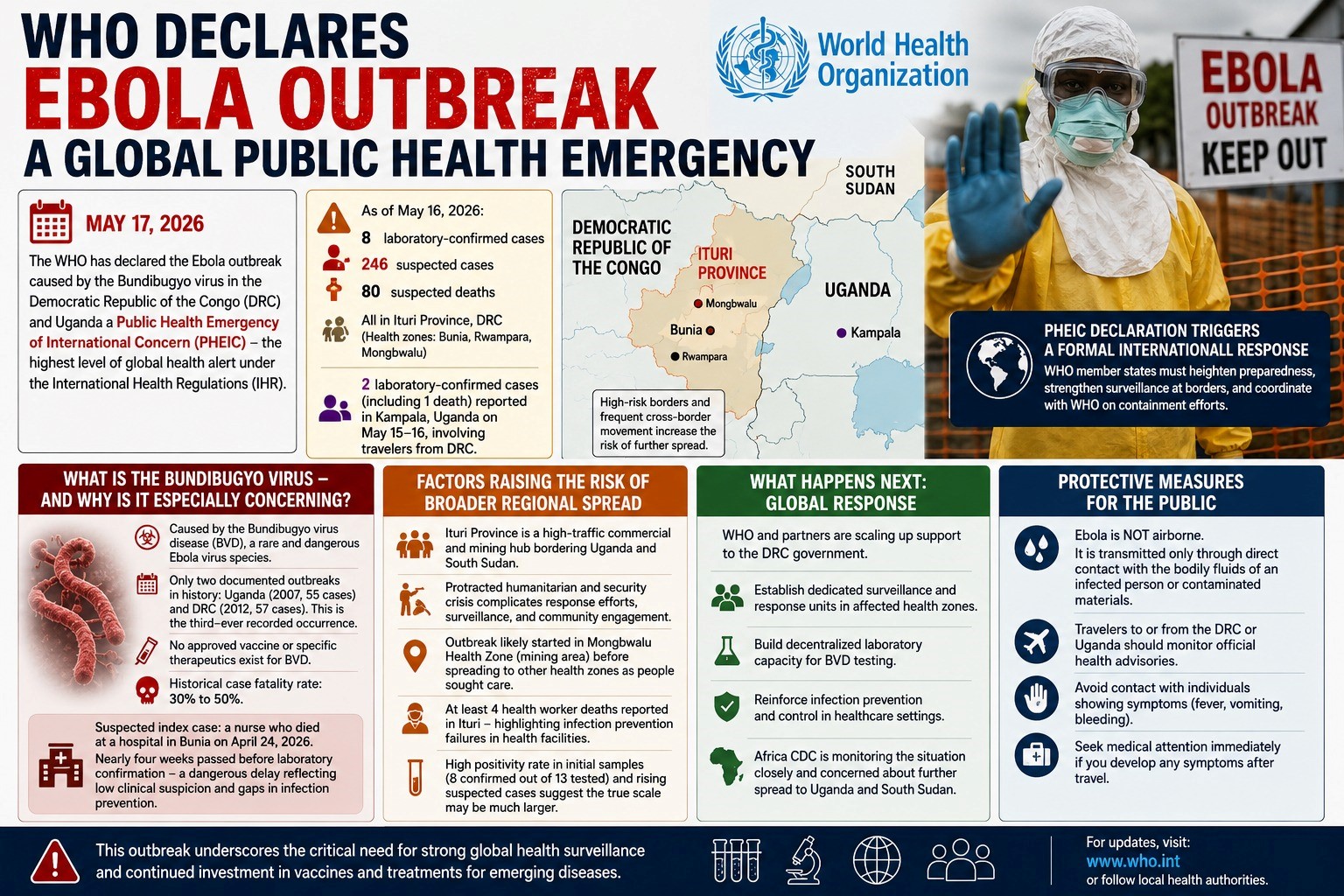
One of the reasons that alerts regarding the distribution of this virus are so crucial is the need for timely information, especially regarding epidemics, can decrease the threat of an epidemic due to delays associated with both reporting and responding. If health systems already operate under a significant strain, early cases of an epidemic may not be contained before the full response to an epidemic will be implemented.
Why businesses should care
The World Health Organization may not recommend any travel restrictions, but the market can react very quickly to a PHEIC declaration. Travel operators, border authorities, logistics companies, and multinational employers begin to evaluate their exposure (particularly for employees working across Africa and neighbouring countries).
Insurance is another consideration. Health-related emergencies often compel businesses to review event coverage hotlines; however, companies that have employees/suppliers/clients in this region will likely have to increase their monitoring and communication efforts rapidly due to both illness risks and continuity.
One reason this announcement hits business leaders so quickly is that Ebola is not just a health headline; it is an operations problem. Companies with staff in or near affected regions may have to rethink travel approvals, remote-work contingencies, medical support, and supply routes almost overnight. Even firms with no direct footprint in Central Africa can feel the ripple effect through shipping delays, border checks, and investor caution. In that sense, a PHEIC is less about fear and more about forcing organizations to tighten their risk management before disruption starts to spread.
The public health logic behind the alert
The recent decision by the World Health Organization (WHO) illustrates a trend that has emerged with outbreaks: declaring as early as possible if the cost of delayed action is potentially much higher than the cost of responding too quickly. This is exceptionally true for Ebola because the disease has historically required rapid contact tracing, isolation, vaccination (where available), and border coordination to prevent it from spreading regionally.
By declaring an emergency, WHO gains additional power to make "temporary recommendations" to countries. While this does not automatically result in lockdowns or bans, it will encourage governments to work together more cooperatively in their responses, which is critical given that there are already cross-border cases of the virus.
What to watch next
Containment or it will develop further. The World Health Organization has indicated that there is potential for the size and scope of this outbreak to be larger than currently reported case counts. Therefore, local public health systems, surveillance capabilities, and reporting must be closely monitored in the coming weeks to assess whether they can handle this situation.
For businesses, rather than acting rashly, considering multiple scenarios is a good indication. This includes reviewing travel by employees or employees due to travel restrictions; supply chains that may be affected by the outbreak; and having any contingency plans or communication strategies ready should this outbreak expand.
This public health emergency of international concern does not mean that we're getting a global lockdown; however, it does change the risk landscape for businesses wherever they operate.
The key message is that a public health emergency (PHEIC) will create a greater urgency for businesses to prepare than they would typically face at the time. When the World Health Organization gets involved in an outbreak response, the cost of being ill-prepared will rapidly increase. Companies that operate internationally should leverage the current environment to be ahead of the curve rather than waiting until there is an immediate impact to their bottom line.
Latest Posts