

US President Outlines Gaza Framework as UN Security Council Convenes
Yet a week later, the agreement doesn’t look like a finished deal but a framework that two of the three parties, Hamas and Israel have received very differently.
The announcement followed a conclusion and a finalized roadmap for the ceasefire’s next phase through the Board of Peace and International Stabilization Force created. Nickolay Mladenov, the Board of Peace's high representative for Gaza presented a measured approach while addressing reporters as: “"It took months of very difficult negotiations to get here. What happens next matters even more.", emphasizing that the agreement is an important first step, but whether what has been agreed actually begins to play out in the current moment is something that no one can predict just yet.
Table of Contents
- The 15-Point Roadmap
- Israel's Response: Skepticism, Not Agreement
- Hamas's Side: Dissolving Its Governing Authority
- The UN Security Council's Ongoing Role
- Why "Historic" Doesn't Mean "Settled"
- What Happens Next
- Conclusion
The 15-Point Roadmap
The Board of Peace posted the full 15-point roadmap on social media the following morning. Its provisions include:
1. reaffirmed commitment from all parties to Trump's original Comprehensive Plan and UN Security Council Resolution 2803
2. Personal weapons in Gaza becoming subject to regulation by NCAG
3. The transitional Palestinian administrative committee, which would hold sole authority to register weapons and issue or revoke licenses
4. Militia weapons being decommissioned and stored under NCAG authority according to an agreed timetable, with a still-unidentified Palestinian party tasked with conducting an initial weapons inventory and taking delivery of Hamas's arms, tunnel maps, and manufacturing sites.
5. A locally recruited Gaza police force is also set to be established and would take control and oversee the transition and development of the regions vacated by Israeli and Hamas troops.
Notably, HAMAS also dissolved its governing authority over Gaza, something they held firmly for over two decades while transferring the official governing power over the region to NCAG as part of the agreement.
Israel's Response: Skepticism, Not Agreement
Israel remains as the most important yet the most complicated party to the agreement. US and Board of Peace officials briefing reporters during the agreement and 15-pointer announcement were clear with regards to Israeli skepticism towards the plan and the absence of a clear agreement or commitment from Israel.
Israel's UN Ambassador, Danny Danon, has time and again reiterated that Israel would not take any further steps before Hamas’s complete demilitarisation which indirectly puts Israel’s sequencing requirements at odds as the roadmap was planned as a phased, parallel progressive steps instead of a "disarm first, withdraw after" structure. Yet there’s still something to be hopeful about as Israeli officials also mentioned that the sequencing and withdrawal would be addressed in future talks, showing glimmers of hope for open negotiation on the matter.
Hamas's Side: Dissolving Its Governing Authority
Hamas on the other hand has publicly agreed to the agreement, with the intention of it being "aimed at fully ending Israel's war on Gaza," including provisions to disarm in stages, on the condition that Israel commits to withdrawing its forces within a defined timeline. At the same time, there have also been reports of Iran’s attempts to convince Hamas not to sign the agreement at all, something that could spark further conflict within Gaza;s armed factions and their regional support while also taking a moment to focus on the true interests of the agreement.
Regardless of how the roadmap or the future plays out, Hamas’s move for disarmament of its government and formal transition of power to the NCAG marks a significant move towards escalation of the region. And whether that stays, and actually also includes transfer of weapons is a question to be answered in the coming days.
The UN Security Council's Ongoing Role
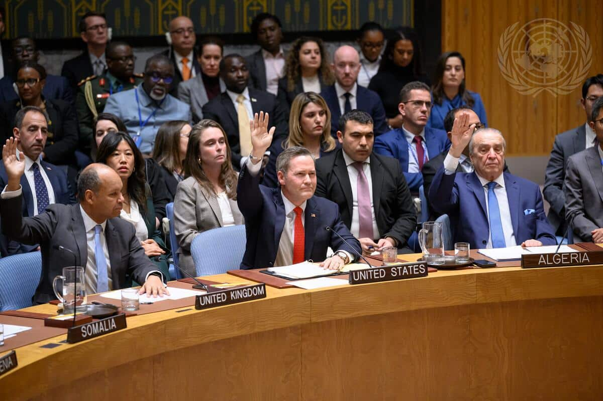
The UN Security Council’s Role in this Agreement isn’t a one-time or temporary oversight during transition, but an ongoing mandate for many months to come. UN Security Council Resolution 2803, adopted in November 2025, aligned with Trump's original Comprehensive Plan and formally authorized the Board of Peace and the International Stabilization Force, while requiring the Board to submit a written report to the Council every six months. Throughout 2026, the council has held brief monthly meetings to discuss durable solutions but Under-Secretary-General Rosemary DiCarlo has also repeatedly stressed that a durable agreement in the region is neither guaranteed nor permanent.
Previously during the February session, DiCarlo had also described talks as "pivotal," adding: "that opening is neither assured nor indefinite", something that has proven true over the past few months. It’s important to note that the Security Council isn’t simply in the loop, but it maintains a formal reporting relationship with the Board of Peace and a standing interest in whether Resolution 2803's terms are actually being met, not just announced.
Why "Historic" Doesn't Mean "Settled"
The announcement and annotation of it being “historic” definitely marks a major step of progress in the conflict and negotiations that have stalled for months, yet they’re still a bit far from an actual mutual agreement. CNN also highlighted "major caveats" alongside the announcement while various news agencies from Al Jazeera to The National have nudged their emphasis upon the gap between Trump' s announcement and Israel’s lack of public acceptance of the agreement. And this gap is bound to have a significant impact on the outcome of the current agreement from being an actual historic moment to another attempt at a framework.
What Happens Next
The roadmap announced by the US President calls for a precise disarmament timetable to be finalized within a defined window, subject to extension if approved by an international verification body and agreed to by all parties. Considering Israel’s firmness on refusal to withdraw from the yellow line until Hamas’s demilitarization is verified complete, and Hamas’s position that its own further steps depend on a defined Israeli withdrawal timeline, the sequencing of these steps are sure to be the major concerns for the week ahead, rather than the actual compliance of the agreement.
Conclusion
Thursday’s announcement and the official 15-point roadmap based on the agreement marks significant steps towards descalation in what has been a region of tension for years. Hamas has begun with the concrete step of dissolving its governing authority, and the UN Security Council continues its formal oversight role under Resolution 2803. However the observed skepticism displayed by Israel, the lack of a clearly defined withdrawal steps and timeline along the Iranian pressure on Hamas all point towards the actual difficult part of the agreement that Mladenov warned about - not the agreement, but its execution. And whether this execution works out exactly as planned, is something nobody can say for certain just yet!
Latest Posts