

US-Brokered Russia-Ukraine Peace Talks Resume in Abu Dhabi, the First Since February, as Witkoff and Kushner Carry the Message to Moscow and Dublin
With their loved ones who finally return home safely from the borders. And while we might continue to remain far away from a definitive agreement, this week’s meeting marked a positive first step, one that is being undertaken with conscious caution.
Table of Contents
1. Why the Talks Went Quiet
2. Inside the Room in Abu Dhabi
3. The Outcome: A Swap, Not a Settlement
4. Moscow and Dublin: The Aftermath
5. Where Each Side Stands
6. Strengths and Weaknesses of the US Approach
7. What to Watch Next
8. Conclusion
Why the Talks Went Quiet
The last trilateral meeting between the Ukrainian, Russian and US Diplomats had taken place back in February in Geneva, concluding without a successful breakthrough, an outcome that has nearly dragged the war for another whole year. The talks had also stalled following the United States and Israel launching their own war against Iran, leaving minimal room and bandwidth for forming diplomatic arrangements. Over the last month, U.S diplomat Witkoff met Putin in St. Petersburg last month, a meeting that reignited hopes for a new round of talks to be held in Abu Dhabi in November. Soon after, U.S President Trump claimed that he had met Russian envoy Kirill Dmitriev privately on November 5 and a “big agreement” would be achieved without divulging into the details of the matter.
Inside the Room in Abu Dhabi
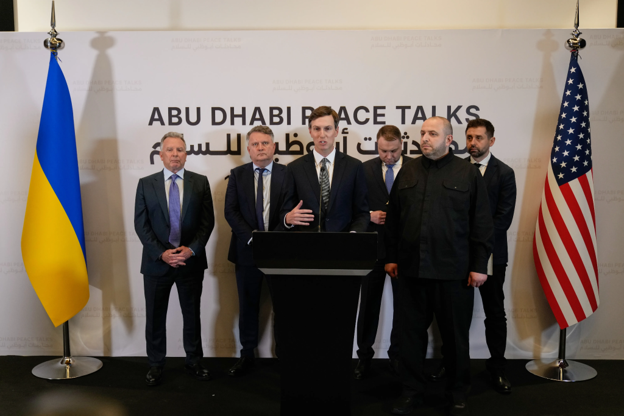
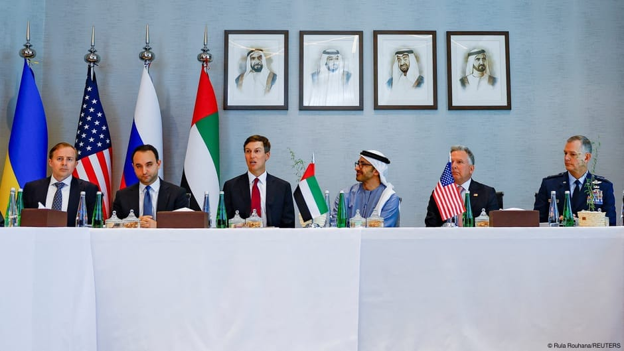
In Abu Dhabi, the talks extended over two days on November 10 and 11 with the first session lasting more than four hours before breaking to resume the next day. While neither Secretary of State Marco Rubio nor Zelensky was in the room, the negotiations were performed by:
|
Delegation |
Key figures |
|
Ukraine |
Rustem Umerov (lead), Kyrylo Budanov, Serhii Kyslytsia, David Arakhamia, Vadym Skibitsky |
|
Russia |
Vladimir Medinsky (lead), Sergei Ryabkov, Mikhail Galuzin, Igor Kostyukov, Yury Zhigarlovsky |
|
United States |
Steve Witkoff, Jared Kushner |
|
Europe (separate sessions) |
Security advisers from the UK, France, Germany and Italy, plus NATO and EU officials |
Ukraine's David Arakhamia said the Russian side arrived with very strict directives, yet he credited the American mediators with steering the conversation back toward what the post-war picture might look like for both countries. Notably, European delegates had also arrived in Abu Dhabi, but they took separate meetings with the US and Ukrainian teams instead of joining the trilateral sessions or meeting Medinsky or his delegation in another private setting.
The Outcome: A Swap, Not a Settlement
The talks resulted in a positive humanitarian agreement that revolved around a large prisoner exchange which Kushner described as the biggest of the war, without revealing the exact number of exchanges involved. In his previous statements, Zelensky had often mentioned swapping over 1,000 or 1,500 people per side, a number that a Russian general staff official confirmed to be around 1,000 on each side within the next two to three weeks. In their previous exchanges, both sides have only limited exchange of a few hundred prisoners, a number that is largely enhanced in this exchange.
And while the prisoner exchange was the most important headline, there was far little development on other aspects as delegations continued to stand far apart on their requirements of territory, security guarantees and a ceasefire, with Umerov acknowledging that significant differences continued to exist and a lot of work would be necessary to broker an agreement. Russian negotiation lead Medinsky remained much stricter on the matter while claiming that "every inch of our land will be returned to Russia, one way or another.", a clear indication that Kyiv continues to remain unwilling to give up land it controls as the price of peace.
Moscow and Dublin: The Aftermath
Following Abu Dhabi’s meeting, the trilateral envoys flew to Moscow, where they met Putin in the Kremlin for about two hours on Thursday before continuing to Dublin to see Zelensky, a meeting that lasted more than an hour. In addition to the meetings agreement, Putin also proposed a new joint humanitarian mission to Kostiantynivka organized by the two countries' human rights ombudsmen, saying Russia would need five days to clear mines from the area. Additionally, Putin also reaffirmed that NATO could not expand any further, repeating a demand Kyiv rejects.
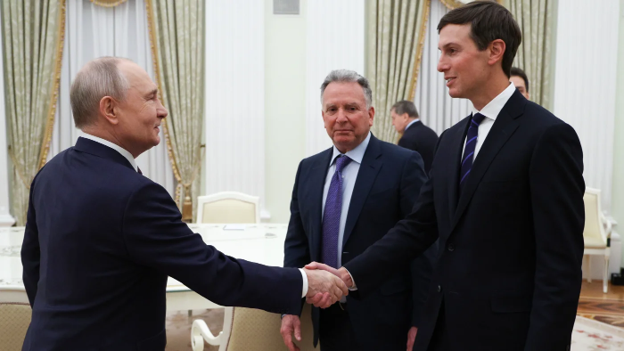
Witkoff also shed light on the possibility of European joining the next round, a possibility that was quickly downplayed by Kremlin aide Yuri Ushakov without any confirmations from Moscow either. Ushakov also added that Putin could take up Ukraine with Trump at the APEC summit in China later this month. In Dublin, where Zelensky was attending the European Political Community summit, he welcomed the prospect of Europe taking a seat at the next round, hoping it would let negotiators deal with postwar security alongside the territorial questions.
Where Each Side Stands
|
Issue |
Russia |
Ukraine |
|
Territory |
Demands Ukraine withdraw from Donbas |
Rejects withdrawing from territory it holds |
|
Ceasefire |
Has repeatedly dismissed an unconditional ceasefire first |
Wants one as the first step |
|
NATO |
Demands a ban on Ukrainian membership |
Seeks guarantees modeled on Article 5 |
|
Europe's role |
Skeptical of a formal seat |
Wants Europe included |
|
Prisoners |
Agreed in principle |
Agreed in principle |
Strengths and Weaknesses of the US Approach
|
Strengths |
Weaknesses |
|
Brought all three sides back after nine months |
No public movement on territory |
|
Produced a concrete humanitarian deal |
Critics say it focuses more on Russia's demands than Ukraine's |
|
Links the war to broader European security |
Europe's role still unsettled |
|
Keeps envoy channels to both leaders open |
Kushner said there is "not great trust" between the leaders |
And while the talks were planned, the war continued far from the boardrooms as Russia struck Kyiv on November 7, in addition to an air strike a day earlier destroying an underground school in the Zaporizhzhia region. Ukraine, for its part, also continued hitting targets deep inside Russia, with reports of a strike on the Kirishi oil refinery. While negotiators talked in a conference room in the Gulf, the power grid, the shelters and the front line carried on as before.
What to Watch Next
While the agreement might’ve sparked hope for those affected, Five things are certain to become significant determinants on whether the progress actually sticks or only marks another attempt.
1. The final prisoner number and the date of the swap
2. Whether the Kostiantynivka mission goes ahead
3. Whether Moscow confirms a seat for Europe
4. When the next round is held
5. What Putin and Trump say to each other at APEC.
Conclusion
Abu Dhabi did what a first meeting after nine months can reasonably be expected to do. It restarted a conversation and produced something tangible for families who have waited a long time. But it continued to evade the core of the dispute as Moscow continues to levy claims on land that Kyiv will not surrender, and within the renewed round of talks, the Kremlin's account of Europe's role differs from Washington's. If the prisoner exchange goes ahead in the scale it has been planned, it could affect and become a significant development for thousands of people, but whether it actually results in the first of several steps or becomes another sparkle that fizzles out can only be determined in the coming weeks.
Latest Posts