

Transportation Secretary Duffy Blames L3Harris Maintenance and Prior Administrations for Nationwide Ground Stop, Declines to Apologize and Seeks 50 Billion in Emergency Air Traffic Control Funding
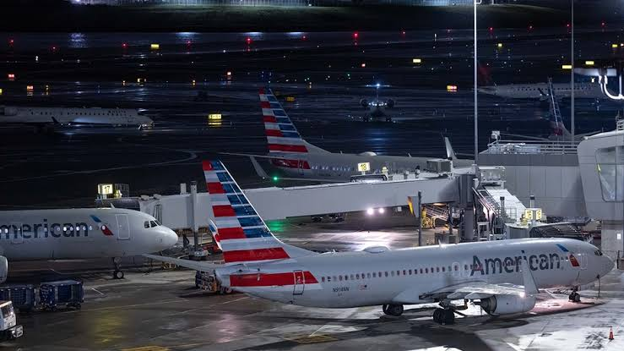
Three days later, majority airlines have resumed schedules but the argument about who's responsible and who should pay to avoid a repeat remains still. Transportation Secretary Sean Duffy pointed to contractor maintenance and decades-old equipment, while refusing to apologize for an incident that he didn't feel responsible for!
Table of Contents
1. What Happened on Friday
2. The Scale of the Disruption
3. What Officials Say Caused It
4. Duffy's Response and His Refusal to Apologize
5. The $50 Billion Request
6. Political Reaction
7. What Comes Next
8. Conclusion
What Happened on Friday
The trouble began around 3:36 p.m. Eastern on Friday, November 13, according to Duffy. Earlier in the afternoon, the FAA had halted flights at both Chicago airports, O'Hare and Midway, because of an equipment outage, while Kansas City's en route center also began a ground stop because of intermittent equipment problems. Within minutes, the disruption amplified to an extent that the agency ordered a nationwide ground stop by 3:54 pm, citing concerns for extraordinary circumstances and safety.
With over 3,500 aircrafts airborne at the time of the order, careful execution allowed flights in the air to land safely. Four hours following the order, the FAA lifted the ground stop at about 8:15 pm Eastern time making it the longest nationwide halt for departures since the September 11, 2001 attacks and just ahead of the January 11, 2023 halt, which lasted roughly two hours.
The Scale of the Disruption
|
Measure |
Reported figure |
|
Duration of the ground stop |
About 4 hours 20 minutes (3:54 p.m. to 8:15 p.m. ET) |
|
Friday flights not completed |
About 12,000 of roughly 50,000 scheduled, per FAA Administrator Bryan Bedford |
|
Friday cancellations and delays |
More than 4,700 cancellations and 10,000 delays, per FlightRadar24 |
|
Saturday cancellations |
More than 6,400 by 9 p.m. ET, per FlightAware, above the FAA's forecast of 4,000 to 5,000 |
|
Sunday cancellations |
More than 1,500 |
|
Previous nationwide stop |
January 11, 2023, roughly two hours |
While the outage from the shutdown remained brief, its damage and implications extended far beyond the ideal capacity. Being shunned out of communication capacities, Aircraft and crews had been pushed to go out of position, while some crews even reached limits on duty time during the outage period.
What Officials Say Caused It
The incident's first account arrived from Duffy during a news conference on Saturday where he said that L3Harris, the FAA's longtime telecommunications contractor, was doing routine maintenance at a remote FAA site in El Dorado, Arkansas, switching communication lines from copper to fiber. During that work, a router began flooding the agency's national network with traffic, producing more than 1,000 connection attempts every four to five seconds. Bedford added that the flooding lasted about 45 minutes and that, unable to determine the cause, the agency ordered the stop as a precaution.
On Sunday, Duffy added that a router in Amarillo, Texas, replaced about three weeks earlier, also began disrupting the system once the Arkansas unit came online. Soon after, both routers were sent for examination to a L3Harris laboratory in Florida while as a precautionary measure, 69 routers of that type in the national airspace had been restricted from broadcasting data.
|
What officials have said |
What remains unknown |
|
A router flooded the FAA network during contractor maintenance |
Whether the cause was installation error, a faulty router or something else |
|
No evidence of a cyberattack |
The final root cause, which the FAA says it will publish |
|
No link to the FAA's AI-based SMART system |
Whether other routers of the same type pose a risk |
|
L3Harris says it is supporting the investigation |
How much of the fault, if any, lies with the contractor |
On Saturday, Duffy reported that officials continued to remain undetermined on whether the incident occurred due to contractor incompetence or a faulty router, a question they explored in the coming days. By Sunday, the cause was more focused towards a poor installation or a faulty router. Addressing the incident, L3Harris said it takes the ground stop's impact seriously and is cooperating with investigators, while also confirming that nearly more than 70 percent of the copper-to-fiber switch has been completed.
Duffy's Response and His Refusal to Apologize
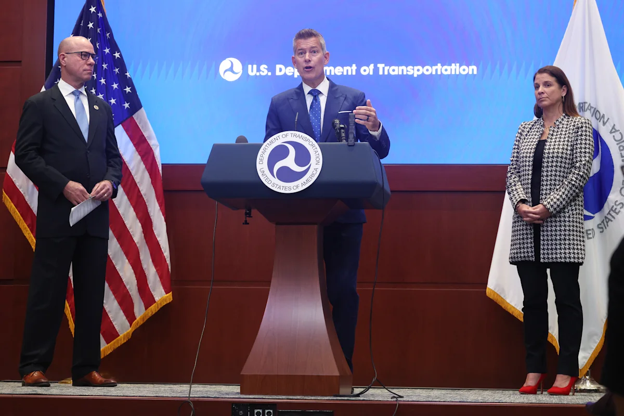
During an NBC special, “Meet the Press” on Sunday, Duffy was asked if he would apologize, a request he quickly dodged while claiming that it might have happened on his watch, but the FAA had been moving at speeds that had never been seen over the past decades. Adding onto his comments, Duffy also claimed that he did not blame either party as the problems spun across both administrations but he also could apologize for what was passed off to him. Bedford, on the other hand, did apologize to affected travelers.
Addressing the matter, U.S. President Donald Trump, who had not commented publicly for two days, wrote on Sunday that the Biden administration had been an FAA disaster and that Congress should provide the money quickly. Notably, the modernization effort has in fact spanned several administrations.
The $50 Billion Request
The Congress had initially approved a $12.5 billion down payment for a new air traffic control system in July 2025. The administration delivered a request for about $30 billion on November 12 but by Friday evening, Duffy had begun requesting for $50 billion, an extra $20 billion that administration officials didn't have time to itemize. Speaking on the matter, he claimed that none of the $12.5 billion can be used for a new telecommunications architecture, and that a new system could be completed around 2028 or early 2029.
|
Arguments for the request |
Arguments against or for scrutiny |
|
Aging equipment is widely acknowledged, and the outage shows the risk |
The extra $20 billion has not been itemized |
|
Duffy says current funds cannot cover a new telecom backbone |
Two Democratic House members say $4.3 billion has been obligated and $1 billion spent of the $12.5 billion |
|
House Speaker Mike Johnson says Congress will take up the request |
Two senior House Democrats say $9 billion of $14.4 billion appropriated since last July is unspent |
|
Major carriers are ready to begin work, Duffy says |
The root cause of Friday's failure is not yet known |
Political Reaction
The reaction for the event and its consecutive development have largely been influenced by individual party lines. New York Governor Kathy Hochul, a Democrat, called on Duffy to resign or be removed, while a White House spokesperson quickly snapped back, describing it as a desperate attempt to score political points. At the same time, Senator Richard Blumenthal has consistently pushed towards conducting a prompt and penetrating investigation while Johnson continued its promise of additional funding through a year-end package during a later session. Nick Daniels, president of the controllers' union, said controllers lacked communications with some aircraft and moved planes to other frequencies, and that action matters more than blame.
As things stand, Transportation and FAA officials met for a brief staff committee on Monday, have reiterated their plans to review the outage, with a Bedford hearing being expected in early December. The FAA has promised a root cause analysis, while the FBI also continues working with the agency.
Conclusion
The narratives surrounding this event have been far more argumentative than factual, making thorough analysis and investigation into the situation a crucial aspect of the process. What began from a router failure during maintenance, shut a larger system down before bringing the nationwide ground work to a pause, every sign of a digital cyberattack without any actual harm. While investigators would focus to unravel whether an individual behind the mistake can be identified or the actual extent of its consequences, the congress and sessions would subtly work around revamping the system to raise them up to modern standards.
Latest Posts