

The Fall of Fable 5 Why an AI Startup Is Suing the U.S. Over Advanced Model Export Restrictions

A federal enforcement of advanced AI export regulations against all foreign persons resulted in a contradiction and a startup that had developed its business in part using Anthropic’s Fable model is suing the U.S. government for interfering with its access to the Anthropic Fable model.
What Happened
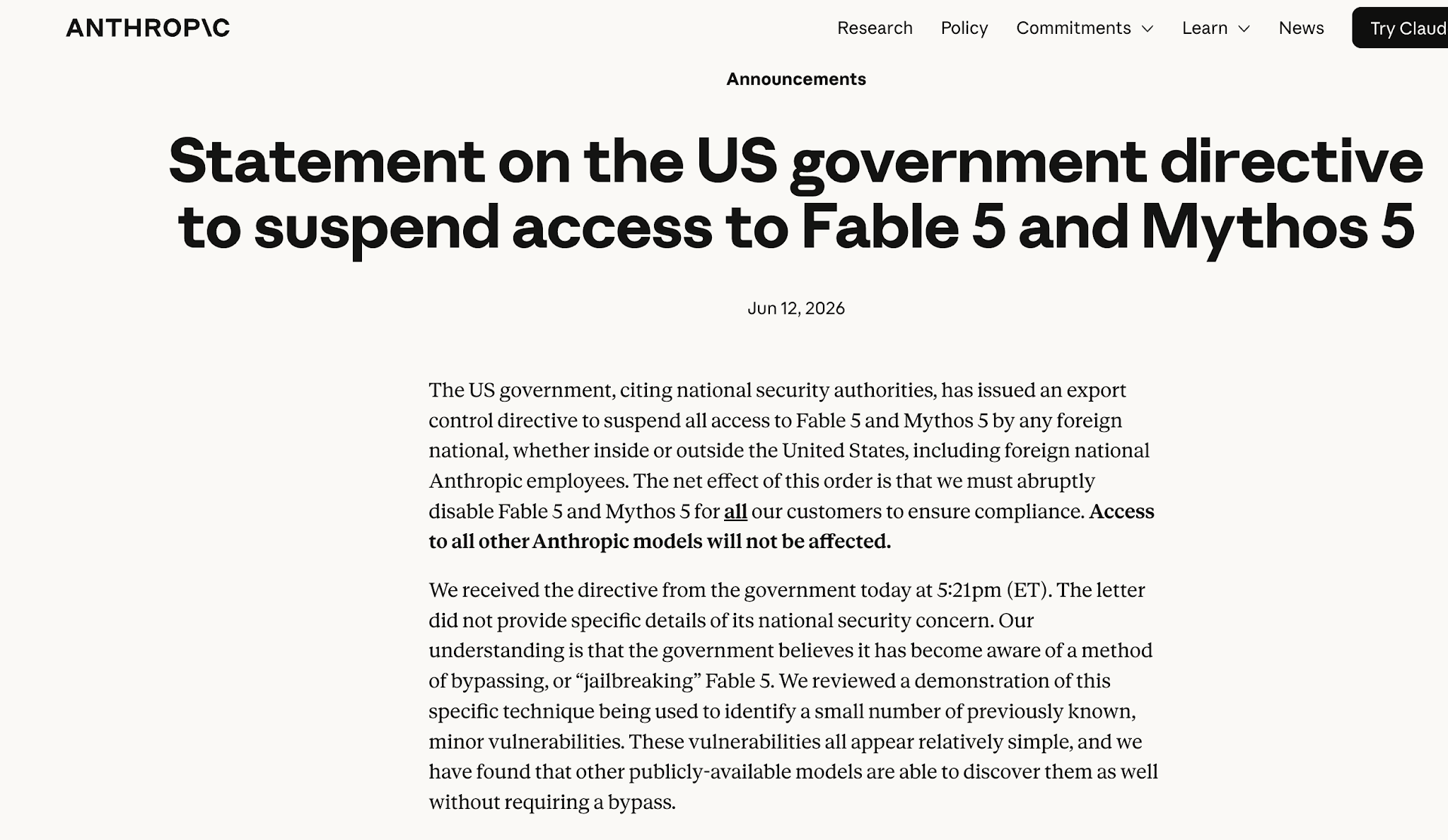
The Commerce Department has ordered Anthropic to prohibit international access to its most sophisticated AI models — i.e., Fable and Mythos. As a result of this action, Anthropic disabled international access to those models, causing a small business to suffer “immediate, irreparable and possibly existential” damage.
According to the lawsuit, the company has lost access to a very important tool overnight. While it may be hyperbolic to say this, for an industry that is built around getting products out quickly, losing access to a top-rated model like that can cause a company to miss production deadlines, delays getting to market, and an immediate and serious disadvantage against competitors.
Why the Restrictions Hit So Hard
Beyond the basic elements of just one model name, the more complicated relationship between national security policy and the global operating mode to which the majority of AI start-ups must comply reflects the underlying friction. Building for an international workforce, bringing together customers from many different countries, as well as having an engineering staff consisting of personnel from multiple countries creates disruptive access restrictions to this type of workflow.
Disruption manifests itself as a factor with the business of start-ups. Access restrictions become much more than just compliance issues if the workflows of start-ups require advanced AI models to code, test, support customers, or implement product iterations. Access restrictions may impact not only the product, but also a start-up's ability to generate revenue and hire employees.
The Policy Logic Behind the Order
The government is likely taking this stance because they are concerned that advanced AI capabilities may be misappropriated by parties outside the U.S.; according to reports, this order is believed to have been issued following a number of recent reports outlining the use of foreign nationals in an attempt to obtain access to Anthropic’s top-of-the-line AI systems. The Trump Administration has also taken a tougher stance on high-technology export controls than previous administrations.
This is similar to how the U.S. has acted throughout its history with respect to exporting sensitive military technology. The U.S. has always used export control laws as a means of restricting the distribution of strategic technologies. The main difference now is how quickly these situations evolve and change; in the world of AI, the rate at which technology advances means that a single policy decision can dramatically change an AI’s potential impact on the marketplace and the rate at which companies will need to alter their long-term strategic plan and product roadmap.
Why Startups Are Pushing Back
The start-up companies plan to launch a lawsuit against the major social media platforms because they believe that the restrictions create a negative impact on legitimate users as well as bad actors. They feel that the damage will be short term in nature, as engineers will not have the most effective tool to meet product timeline schedules, the ability of companies to generate revenue will be reduced, and/or they will be at a competitive disadvantage that they may never recover from.
This argument carries significant weight in the AI industry, as access to models has become a critical part of normal operations, rather than a luxury item. For example, if a company devotes months to developing a product based around one specific model family, the risk of losing that model now raises a very serious issue for its balance sheet. It is especially possible that smaller start ups may not have any alternate models ready to develop their products.
The Bigger Industry Signal
The conflict described above demonstrates how the artificial intelligence (AI) market is moving into a new level of regulatory environment; The regulation will not only look at the power of machines; but also look at the people who are able to work with those machines (people that are allowed to train models of AI). Therefore, this has implications for corporate customers, investors in business capital and vendors of computer infrastructure since it will impact the pricing of risk and uncertainty associated with developing and deploying of AI applications.
This also brings into question the future of how nations collaborate globally. Historically, much of the development of AI technology, research and products have occurred in an international environment; therefore, if countries put restrictions on exporting products or technology, development teams may have to alter production functions based on geographies and locations instead of capabilities and abilities of individual team members.
What to Watch Next
The first issue is what standard the court will impose on the startup’s injury when determining if it is sufficient basis to deny or narrow the order. More generally, however, there is a larger question regarding how new regulations for frontier AI will affect the ability of companies to continue operating in the commercial environment that has been developing around this technology.
This is what investors, founders, and enterprise customers will be focused on. If these restrictions become standard operating procedures, then AI strategy will require significantly more compliance planning and reduced reliance on the assumption that the best AI model(s) will be accessible and available across every jurisdiction.
The larger lesson to learn from this case, however, is that the fight surrounding Fable 5 is not merely an outcome of one company’s financial loss; it is merely a precursor to the increasing dispensation of regulatory interference that will characterize the subsequent evolution and expansion of the AIE.
Latest Posts