

OpenAI Launches GPT-6 The Agentic Revolution Begins
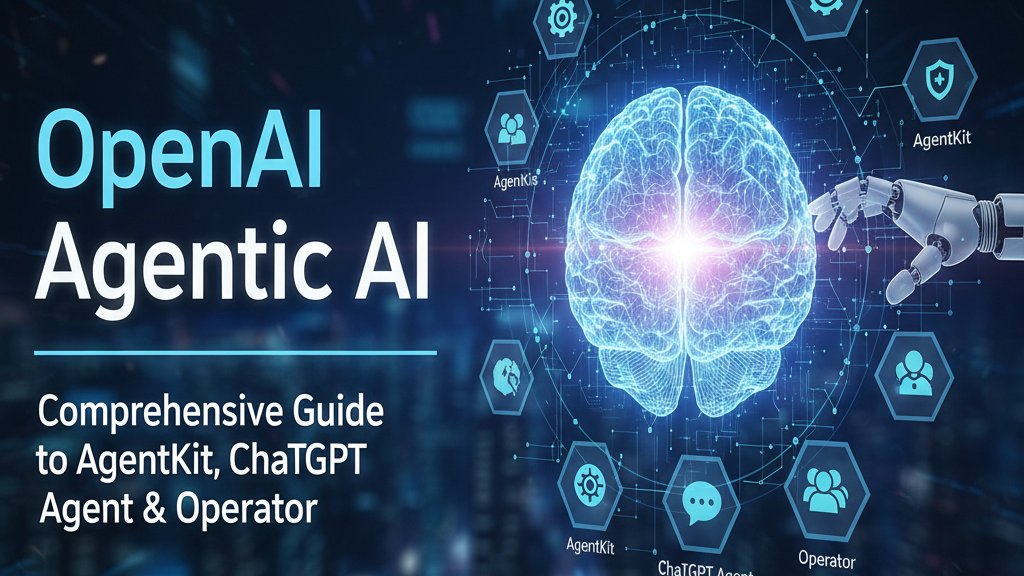
Where prior models responded to prompts, agentic AI is designed to function independently from humans, to complete a series of tasks that may be linked together to create an overall goal. Instead of focusing on “What can AI create?, businesses will be changing their focus to “What can AI operate?”
What “Agentic” Really Means
In general terms, the definition of agentic is straightforward. A system becomes agentic when it can continue to work on a goal through multiple steps without the need for constant human input. This can include determining what information is needed, developing a plan, using tools, verifying its own work, and changing direction when the circumstances require it. Therefore, the system can be said to be working independently, rather than only reacting to the environment.
It is especially important to note that the majority of business process flows are not simple step processes, they are complex flows of multiple steps. Examples of these include a sales follow-up, a research brief, conducting a competitive analysis, and escalating customer support issues; all of which require judgement, coordination, and context, in order to accomplish the business objective. If GPT-6 can assist with these complex business process flows in a reliable, efficient manner, the value of the product will not be limited to basic content generation or providing a chatbot to answer questions; it will become a greater contributor to the development of a new type of digital workforce.
Why Businesses Should Pay Attention
The main benefit for companies will come from better speed than they can achieve today. But, even more important is automating processes that used to be entirely driven by human interaction (think about things like scheduling meetings, drafting reports, qualifying sales leads, comparing vendors, internal documentation, triaging workflows, and even simple decision-making support) using a model that can move through each step with minimal friction. Such a process will give a company significant time savings, decrease their labour costs, and make small teams appear larger than they are.
The above situation is especially applicable given the current environment where many companies' senior leadership is under tremendous pressure to do more with fewer resources. The cost of hiring employees is high, profit margins are very tight/low; and there is fragmentation of knowledge work throughout multiple applications. Therefore, developing an AI productivity layer to connect the various pieces of the business will be able to solve the handoff issue associated with many aspects of business practices. A large portion of business inefficiency is tied to people waiting for other people to get something done. An agentic system can reduce the waiting time experienced by employees due to other employees' indecision.
The Promise and the Risk
Clearly, increased levels of autonomy bring greater levels of risk to an organization. Once a model becomes capable of performing activities autonomously, organizations must have a more serious approach to defining guardrails, granting authority for actions and having appropriate systems for supervising what's done on behalf of an organization. For example, having a system produce an email draft is easy. Having a system email that drafts, schedules a meeting, updates your CRM and/or executes any other automated action can create large amounts of productivity gains but also creates large amounts of risk without appropriate governance process.
As such, enterprise AI strategy will evolve from being based upon experimentation towards creating and enforcing governance policies. Governance policies should articulate how much authority an AI-based agent has to perform actions, when an agent should seek authority before performing actions, how errors will be tracked and/or reported and who will be responsible if an action performed by an agent produces an adverse result. Although that may sound like a very conservative view, it is also the sustainable way to successfully implement AI based automation. There are no credible organizations that wish to implement an automation solution without the ability to validate the appropriateness of actions taken on behalf of the organization.
A Shift in Software Itself
One of the many interesting things about GPT-6 is that it could fundamentally alter how people use software. Instead of wasting time clicking endlessly through different menus and dashboards, users will likely begin describing their desired result and then let the system determine how to accomplish it on its own. This has the potential to change the way products are designed, change the expectations of customers, and even change the way that software companies compete with each other.
In this scenario, Agentic AI will no longer be viewed as merely a feature and instead will be treated as being intrinsic to the way in which the user interacts with the application. Companies that previously won on the basis of providing a clean user experience via ‘creating clean dashboards’ will instead need to provide value through ‘creating an intelligent assistant.’ This represents a subtle yet significant shift, from providing static tools to providing systems that can understand the user’s intent and carry out actions.

What to Watch Next
The primary concern about GPT-6 is whether it will be able to balance autonomy with reliability. Businesses are not looking for fancy AI; they want it to be reliable, safe and useful in unpredictable real world environments. If the model can meet this described mandate, it will become ubiquitous across the complete workflow of both internal and customer facing operations.
This is why this release is so important. This is not just about a more highly rated model and a more intelligent chatbot; the big question is if AI is truly ready for the transition from assistant to operator. If GPT-6 can accomplish this goal, its impact will be felt well beyond the technology sector and dramatically affect how work is delegated, how software is developed and to what level routine business processes are automated without losing human judgment.
Latest Posts