

Nvidia Acquires AI Platform Hugging Face as Its Investment Portfolio Swells to 99 Billion
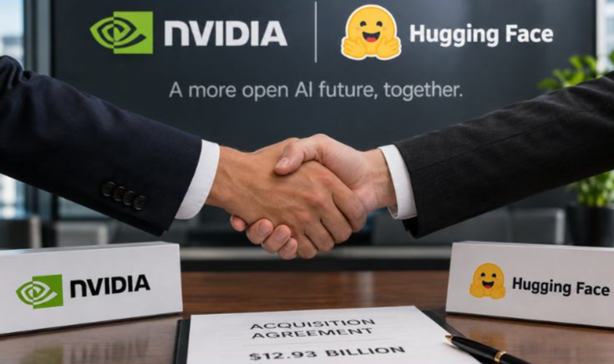
While many would not have even considered Nvidia acquiring other companies in its portfolio over two years ago, today Nvidia’s side project has become an empire in itself with an investment Portfolio as heavy as $99 billion with its latest acquisition of one of open-source AI’s most important platforms, Hugging Face for a whooping $12.9 billion.
Table of Contents
1. The Hugging Face Deal, Confirmed
2. What Hugging Face Actually Is
3. Why Nvidia Wanted It
4. The $99 Billion Portfolio, Explained
5. Where the Money's Actually Going
6. The "Vendor Financing" Concern
7. Nvidia's Biggest Deals: A Quick Comparison
8. Conclusion
The Hugging Face Deal, Confirmed
On Thursday, September 3, Nvidia announced that it had entered a definitive agreement to acquire Hugging Face, the widely used open-source AI platform, for approximately $12.9 billion. The agreement includes an equity-based retention program for Hugging Face employees who join Nvidia, a move aimed to maintain stability across the platform’s existing team during the transition and awaits pending regulatory approval while being projected to close by the first half of 2027.
Hugging Face CEO Clément Delangue while speaking to CNBC addressed, "During the summer, I think we realized that Hugging Face and open-source AI in general was at the turning point, and that it needed more, more resources, more scale, more visibility,". Delangue in turn claimed that it was Hugging Face that contacted Nvidia for the move while describing the relationship with Nvidia to have felt like "a perfect home".
What Hugging Face Actually Is
Hugging Face in itself is a humongous entity with over 18 million developers, researchers, and creators using the platform to share upward of 3 million AI models, 500,000 datasets, and 1 million applications. Furthermore, more than 200,000 companies rely on it to discover, evaluate, and deploy AI systems. The platform isn’t simply a single product but rather an entire shared collective for open-source AI, hosting a huge share of the field's collaborative infrastructure.
And that magnitude of importance across the industry is what makes the acquisition a notable affair, even within Nvidia’s own shareholders. Huang has committed publicly to keeping Hugging Face "an open platform for the entire AI ecosystem" post-acquisition, an important reassurance given how much of the open-source AI community depends on the platform remaining accessible to neutral users and on neutral ground rather than becoming a walled garden for Nvidia’s ecosystem.
Why Nvidia Wanted It
Hugging Face’s acquisition for Nvidia is part of their larger, more recent strategy of moving beyond selling chips and rather focusing on the larger AI stack that also runs on top of them. Huang framed the logic directly in his announcement, describing Nvidia's "full-stack platform" as uniquely positioned to help governments, cloud providers, and enterprises build AI infrastructure and then "connect it to offtake demand from our vast developer ecosystem."
Analysts read the move similarly. CFRA Research's Angelo Zino explained the deal as being less focused on the financials of the near term but of greater value in the long-term ecosystem control while BD8 Capital's Barbara Doran believed it to be a great strategic move that positions Nvidia to become more of an AI platform and infrastructure rather than limiting itself to being a supplier of chips.
The $99 Billion Portfolio, Explained
The Hugging Face deal landed the same week Nvidia disclosed that its broader equity investment portfolio had reached $99 billion as of July 26, a staggering incline in value from its $7 billion portfolio a year earlier and just $2.2 billion two years ago. The portfolio now breaks down into roughly $43 billion in publicly traded securities, $48 billion in private company stakes, and $3 billion in equity-method infrastructure investments, based on Nvidia's latest quarterly filing.
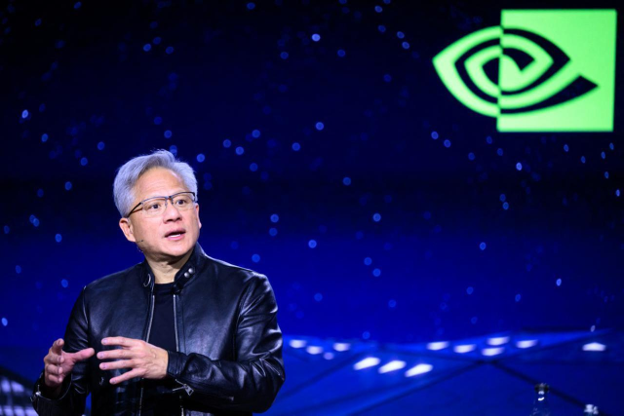
And a portfolio of that value puts Nvidia among the largest strategic tech investors in the world, though it still trails Alphabet, whose equity portfolio stood at $232 billion at the end of June, boosted heavily by a $94 billion stake in SpaceX following that company's IPO.
Where the Money's Actually Going
|
Investment |
Reported Value |
Sector |
|
Intel |
$30 billion (up from a $5 billion initial stake) |
Chip manufacturing |
|
SpaceX |
$21 billion (as of June) |
Aerospace/satellite infrastructure |
|
Lumentum, Coherent, Marvell |
~$2 billion each |
Photonics/optical networking |
|
CoreWeave |
$2 billion (January 2026) |
AI cloud infrastructure |
|
Nebius |
$2 billion (March 2026) |
AI cloud infrastructure |
|
Hugging Face |
$12.9 billion (acquisition, pending close) |
Open-source AI platform |
Nvidia's equity strategy spans nearly every layer of the AI stack, and its CFO, Colette Kress, claimed that the company has invested "nearly $50 billion in the frontier AI labs" alone. Within the near future, Nvidia has also committed more than $40 billion in financing deals in 2026 alone, and separately announced partnerships aimed at mobilizing over $500 billion in financing for its own GPUs, along with up to $105 billion in conditional credit support for an OpenAI data center project in Ohio, figures that would not be included within the equity portfolio but would be humongous leaps in its strategy to acquire capital and strengthen its position across the AI Industry.
The "Vendor Financing" Concern
Nvidia’s strategy and acquisitions may appear to have established its positions firmly, but the strategy has also garnered its own set of critics. Amongst the many critics, one common flaw being discussed is Nvidia investing in companies that use majority of that investment capital to purchase Nvidia’s chips itself, similar to the vendor financing agreements that inflated the dot-com bubble in the 1990s. And while this could benefit Nvidia in the short-term, it raises a structural dilemma as being both the primary supplier and financial backer of its own customers could indirectly mix its own capital to manage demand of its products rather than allowing the demand to be independent within the market. And somewhere for Nvidia, it ensures a foolproof investment path, for even if the companies fail, it would’ve recouped the investment and if they succeed, provided Nvidia a stronger foothold within the AI Landscape.
Nvidia's Biggest Deals: A Quick Comparison
|
Deal |
Value |
Year |
|
Groq asset purchase |
$20 billion |
December 2025 |
|
Hugging Face acquisition |
$12.9 billion |
September 2026 (pending close) |
|
Mellanox acquisition |
~$7 billion |
2019 |
Nvidia’s Hugging Face purchase quickly became Nvidia's second-largest acquisition on record, just behind its Groq asset deal from late 2025 while being a significant margin ahead of its long-standing prior benchmark, the 2019 purchase of Israeli chipmaker Mellanox.
Conclusion
Nvidia’s week was characterized by two significant but not so distinct headlines, a $12.9 acquisition of a platform used by 18 million developers and a tally of $99 billion in equity stakes, a portfolio value that barely existed two years ago. And while only the future could predict the outcomes of Nvidia’s investment strategies, the company has smoothly established its vision and direction of not being content to simply build the chips for the AI industry but to also have larger stakes with meaningful chunks across the labs, the clouds, the infrastructure, suppliers and now with Hugging Face, the software that connects it all. And now whether the control and ownership at each level strengthens the AI ecosystem or rather creates a self-reinforcing capital loop crisis that many are critical about, is bound to become the larger open questions around Nvidia for the next few years.
Latest Posts