

Meta Releases Glimmer, a New Open-Weight AI Model Anyone Can Download and Run Locally
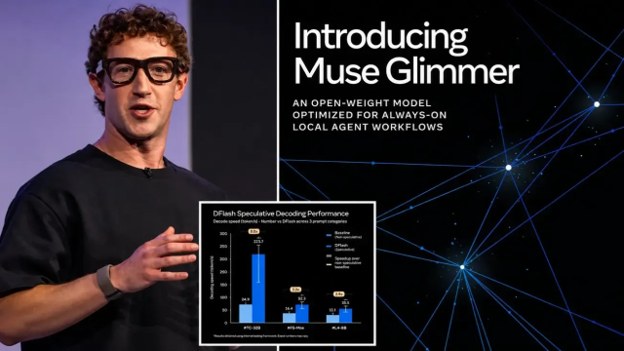
In a shift from this traditional model, Meta recently pitched its latest release - the Muse Glimmer, an AI that lives entirely on your device, using your tools and monitoring your activity to support you, without ever sending data back to the company servers. And while the model continues garnering support and criticism across the industry, it’s bound to pave a new direction within the world of AI models.
Table of Contents
1. What Muse Glimmer Actually Is
2. Why Meta Released It Now
3. How It Performs Against the Competition
4. Muse Glimmer vs. Qwen 3.6 27B: Head to Head
5. What Running It Locally Actually Requires
6. Pros and Cons
7. The Bigger Picture: America vs. China in Open AI
8. Conclusion
What Muse Glimmer Actually Is
Muse Glimmer, a 30-billion-parameter dense model that is built upon similar foundations as the company’s larger closed model, Muse Spark, was launched on August 10,2026. The model has been licensed with an Apache 2.0 license, the most permissive terms that a model from Meta has presented while replacing the Llama license that was used for the previous Llama generation of AI models. In practice, the license enables developers to download it, modify it as well as build their own commercial products and versions of the model entirely on their own desktops, with almost no strings attached.
Built for a slightly different purpose from Meta’s previous chatbots, Glimmer is purposefully designed to cater to agentic works like calling tools, writing and debugging codes, managing failures mid-task as well as analyzing its own outputs. The model is built to support a 128,000-token context window, was trained on a database spanning more than 100 languages and is capable of reading images alongside text through a dedicated perception encoder. Meta has also designed Muse Glimmer to run offline on a single high-end consumer GPU, with quantified versions and a speculative-decoding "drafter" tuned specifically for 24GB machines, a specification that a hobbyist or a small dev team might already have built, while being far away from the mechanics of a data center.
Why Meta Released It Now
Muse Glimmer’s launch was paired with a 6,500 word essay by Meta’s CEO Mark Zuckerberg with the title “ The Future Is For Everyone, a subtle argument that the US and its allies need to be at the forefront of the open-model ecosystem rather than withholding it and ceding to Chinese labs. Zuckerberg also announced his plans to make the more powerful Muse Spark 1.2 model available openly within the coming weeks, while also revealing a $1 Billion fund aimed to assist the communities near Meta’s data centre, a company strategy to manage and minimize the growing local resistance to Meta’s AI infrastructure buildout.
With Meta’s announcement a couple months ago, announcing its plan to spend up to $145 billion on AI infrastructure within the year, investors had grown skeptical about its plan and Meta’s shares dipped by 10% as a result. Following the release of Muse Glimmer and its investment plans for the local communities, Meta again witnessed a 3% rise in premarket trading, a promising sign that the market considers Meta’s open-source pivot and communal growth pivot as reassuring.
How It Performs Against the Competition
Muse Glimmer’s independent benchmarks from Artificial Analysis provide a mixed insight into the models capabilities with different strengths and weaknesses across a variety of functions. Glimmer scored 24% on the Tau3-Banking agentic benchmark, surpassing the likes of Gemini 3.5 Flash-Lite and Qwen3.6 27B but was beaten in the knowledge calibration test with a 82% hallucination rate while Qwen3.6 27B had only obtained a 49% hallucination rate, despite raw factual accuracy remaining roughly similar between the two.
In the safety tests, Glimmer managed a 28.4% attack-success rate on the Siren AgentDojo prompt-injection benchmark, a worse score than Gemma who managed a 25.6% but a better one than Qwen's 40.3%. The model also secured the highest utility score across the three models with a utility rating of 94.2. On a privacy benchmark measuring how often a model leaks information it shouldn't, Glimmer scored 26.4, better than Qwen's 53.4 but worse than Gemma's 12.1.
And if you’re worried about the mixed results, it only shows that Muse Glimmer wasn’t built to compete on every leaderboard, but simply as a useful, always-on local agent to support individuals.
Muse Glimmer vs. Qwen 3.6 27B: Head to Head
Muse Glimmer’s closest similarity in model design lies with the Qwen 3.6 27B, with both models running a dense, Apache 2.0-license and being sized to fit in toughly 18-24 gb of VRAM and comparisons between the two depict a mixed result rather than establishing a clear winner.
|
Benchmark |
Muse Glimmer 30B |
Qwen 3.6 27B |
Edge |
|
MCP Atlas (tool use) |
75.5 |
62.5 |
Glimmer |
|
DeepSearch QA |
74.6 |
71.1 |
Glimmer |
|
τ³-Banking (financial agent tasks) |
23.5 |
16.7 |
Glimmer |
|
SWE-Bench Verified (coding) |
76.0 |
77.2 |
Qwen |
|
SWE-Bench Pro (harder coding variant) |
51.2 |
50.2 |
Glimmer |
|
TerminalBench 2.1 (command-line execution) |
51.7 |
60.7 |
Qwen |
|
SciCode (scientific programming) |
43.6 |
39.8 |
Glimmer |
What Running It Locally Actually Requires
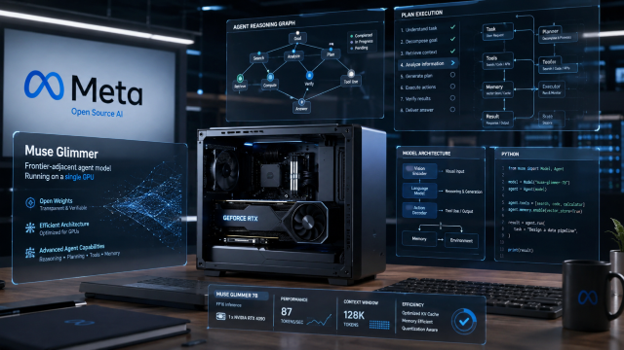
Muse Glimmer by Meta has been built to actually run on consumer hardware in practical terms, and the company launched support during its rollout through Ollama, LM Studio, vLLM, SGLang, Together AI, Fireworks AI, and OpenRouter while optimized llama.cpp, MLX, and ExecuTorch integrations followed in consecutive days of the launch. Meta is also working directly with AMD, ARM, Dell, Intel, and Nvidia to tune performance across different hardware configurations, and has published developer documentation covering custom agent scaffolds.
In a simple and practical term, the model requires a machine with 24 to 32GB of VRAM or unified memory, easily achievable in a high-end gaming PC or a well-specced Mac, but not in a typical professional workstation. The model has actually been built with achievable and practical requirements, a stark contrast to other claims of open-weight flagship releases who often publish requirements that are unrealistic for anyone without server-grade hardware to actually run.
Pros and Cons
|
Pros |
Cons |
|
Genuinely runs on consumer-grade hardware, not just theoretically "open" |
Notably higher hallucination rate than closest open competitor |
|
Most permissive license Meta has ever attached to a model (Apache 2.0) |
Loses several head-to-head benchmarks to Qwen 3.6 27B |
|
No data leaves the device — real privacy upside for sensitive workflows |
Not served on Meta's own API; depends on third-party providers |
|
Strong at agentic tool use, planning, and multi-step task execution |
Weaker on pure coding benchmarks than some rivals |
|
Broad ecosystem support at launch (Ollama, vLLM, LM Studio, etc.) |
Vision and speculative-decoding components still rolling out post-launch |
The Bigger Picture: America vs. China in Open AI
Muse Glimmer’s release isn’t simply Meta’s attempt at providing a reliable and thorough AI model, but also an attempt to retake the open-source AI markets from Chinese labs. In May 2026, Chinese open-weight models accounted for roughly 61% of all tokens consumed on OpenRouter, a popular model-routing platform, with four of the five most-used models on the platform coming from Chinese developers. This has been a stark area of concern, since the Chinese models displaced Meta’s very own Llama, the previous open-weight stand-bearer following the Llama 4’s poor reception in 2025, while also being described as “comparatively mid”
Muse Glimmer marks Meta’s attempt to reclaim that market, with independent analysts evaluating the model as an imperfect, but credible step into that direction while staging a model to compete with the DeepSeek V4 Flash and GLM-5.2 on measures of genuine openness, while trailing the very best Chinese reasoning models like Qwen3.6 27B and Ling 3.0 Flash on raw benchmark scores. While Muse Glimmer may not just yet feel enough to ace every benchmark, Meta’s promise to Open Muse Spark 1.2’s weights could actually change the tides, while marking the first of American lab’s frontier-tier models being released into open circulation.
Conclusion
Muse Glimmer wasn’t designed to become a benchmark-topping flagship and neither is Meta pretending to claim that it could become a model that sustains that requirement. Instead, it’s clearly designed as a genuinely local AI agent that empowers developers while being run on pre-existing hardware and being wrapped in a license that has minimal restrictions for the user. And while Meta hopes that it's a meaningful promise to shift momentum back towards American labs in the Open-Source AI segment, it depends much more on whether Meta delivers on its promises instead of the actual performance of Muse Glimmer.
Latest Posts