

Markets Digest Warsh's Jackson Hole Remarks as Traders Reassess Rate-Cut Odds
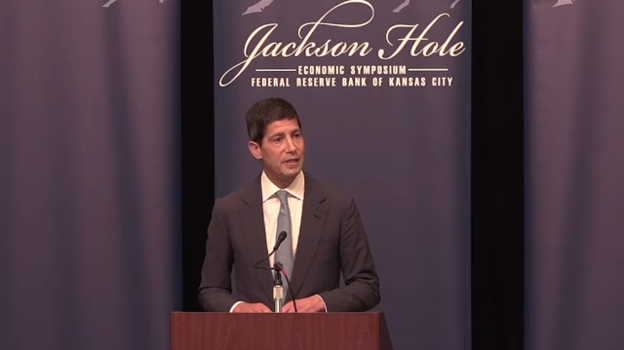
On Friday morning, during his 30-minute keynote address at the Kansas City Fed's annual symposium in Wyoming, Kevin Warsh provided an answer neither too clear nor too vague, just enough for traders to start repricing everything in the markets, a subtle indication for what the future holds for Jackson Hole.
Table of Contents
1. What Warsh Actually Said
2. How Markets Reacted
3. Rate-Cut Odds vs. Rate-Hike Odds: Before and After
4. Why This Speech Was Different
5. The Fed-Treasury Tension in the Background
6. What This Means Heading Into September
7. FAQs
8. Conclusion
What Warsh Actually Said
Warsh’s first Jackson Hole keynote as Fed Chair surprised investors, mainly for his Hawkish approach as Warsh reiterated that with inflation running well above the Fed’s 2% target, the central bank’s focus would need to fixate more on price stability over growth support. Being direct in his first speech, Warsh took a moment to express his dissatisfaction with recent progress, while claiming that despite the summer’s PCE and CPI reading numbers coming in better than previously feared, the underlying inflation trends had also improved, a significant development that isn’t being shown or understood directly behind the improved numbers.
Warsh also pushed back on the notion of the Fed being responsible to indicate a trading signal at every address and encouraged investors to form their own view of the economy and make their decisions instead of simply waiting for the central bank to provide them with indications or guidance for their next move. Another notable topic during the otherwise expected focused-on-inflation speech, was Warsh spending a while to focus on artificial intelligence, while labelling it as a “hinge point” for the economy while also mentioning about the flood of capital pouring into AI Infrastructure, a potential source of growth that Feds would want to factor into consideration for the upcoming future.
How Markets Reacted
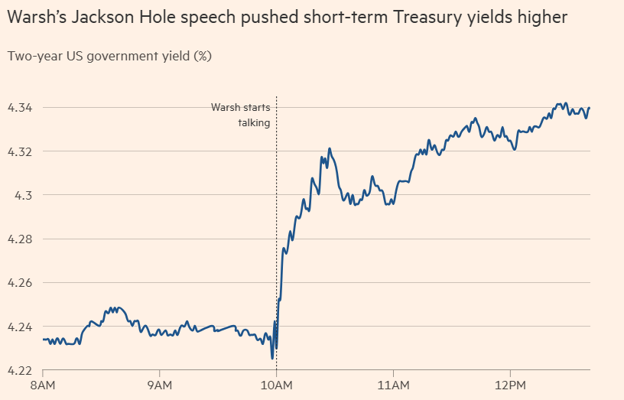
Regardless of Warsh’s choice to avoid providing a direct policy signal, the markets were quick to react with the bond markets analyzing the speech has “hawkish for the near future”, with a result in jump for 2-year Treasury yield rising up by 8 basis points to around 4.31%, the highest level seen since late July. At the same time, the 30-year yield actually experienced a slight decline, offering relief to a long-term market that has experienced significant pressure in the past. The benchmark 10-year yield showed a modest change, moving up by about 2 basis points and holding near the 4.68% mark.
Stocks on the other hand took a contrasting approach by rejecting the harkish frame entirely. Following Fed Chairs speech, the market saw Dow gaining roughly 0.4% while the S&P 500 rose by about 0.3% and Nasdaq witnessed the most gain with roughly 0.5%, an indication that equity investors chose to focus and value Warsh’s AI-and growth related comments far more than being unsettled by his inflation warnings. Within the other markets, Gold slipped on the Hawkish trend, while bitcoin and broader crypto markets maintained themselves in the midst of the speech’s mixed signals.
Rate-Cut Odds vs. Rate-Hike Odds: Before and After
The most measurable and significant reaction was found in the Fed funds futures. According to the CME Group's FedWatch tool, the probability that traders believed a rate hike would be announced at the September 16 meeting, jumped from 35% to 55%, a sharp 20% increase simply attributed to Warsh’s speech.
|
Metric |
Before Speech (Thursday) |
After Speech (Friday) |
|
Odds of a September rate hike (CME FedWatch) |
~35% |
~46–56%, depending on the reading |
|
Odds of no change in September (Polymarket, pre-speech) |
68% |
Lower, shifting toward hike pricing |
|
2-year Treasury yield |
Lower |
~4.31%, highest since late July |
|
30-year Treasury yield |
Near 19-year highs (~5.18%) |
Ticked down slightly |
|
Gold |
Near two-month highs |
Down on hawkish tone |
Why This Speech Was Different
Under the previous Fed Chair Powell, Jackson Hole had become a stable field of investment with investors basing their choices on the direct forward guidance of the Fed Chair. Warsh has consciously chosen to move away from that model and in turn moulded his speeches to be focused on broad, structural framing instead of near-term policy signals.
Warsh has also previously addressed his choice, while defending it as an attempt to move towards the bigger questions instead of indulging in the constant debate of quarter-point moves. This choice of approach however has also garnered Warsh a range of criticism, with Economists such as the former Minneapolis Fed President Narayana Kocherlakota arguing that such uncommunicative style creates unnecessary volatility in the market, making it a dilemma for the investors to invest with the fear of the Fed’s reaction instead of reading it clearly.
The Fed-Treasury Tension in the Background
Fed Warsh’s speech had become a high-stake address, mainly due to a subtly developing friction between the Fed and the Treasury Department this summer. The 30-year Treasury yield hit a 19-year high above 5.3% earlier in August, prompting Treasury Secretary Scott Bessent to intervene by expanding the government's long-term debt buyback program, a strange move that raised questions of Treasury attempting to do the Fed's job of managing long-term borrowing costs.
Warsh, for his part, has previously suggested he's comfortable letting bond yields rise as a market-driven form of tightening, a stance that puts him somewhat at odds with Bessent's efforts to hold long-end yields down. Friday's modest dip in the 30-year yield, even as short-term yields jumped, suggests that tension hasn't fully resolved — if anything, it's part of why the "bear flattener" move looked the way it did.
What This Means Heading Into September
The immediate market reaction suggests that a September Hike, which seemed like a distant possibility, has now become a consensus for half of bond traders, even more as a real near-term outcome than a September cut. The speech also gathered split reactions with Navy Federal Credit Union's Heather Long, suggesting that even if the Fed doesn't hike in September, the door is now open for a move by October or December if inflation data doesn't improve.
For everyday borrowers, the more immediate effect runs through the 2-year yield and short-term lending rates tied to it, while the 30-year yield's slight pullback offers a bit of breathing room for mortgage rates, which track the 10-year more closely than the Fed funds rate itself. Whether that relief holds will depend heavily on incoming inflation data between now and the September 16 FOMC meeting.
Conclusion
Friday’s speech may have disappointed or put many on alert, but it was exactly what the Fed Chair Warsh wanted, a no headline-grabbing policy declaration, no Q&A to pin him down further, and a market left to do the interpretive work itself. And the market reacted in splits as well with the rate-hike odds for September nearly doubling within hours while the Treasury yields relaxed with the announcement and the stocks rallied on the hopes of his AI comments. But as things stand, the bigger picture hasn't fully resolved: the tension between the Fed and Treasury over who's really steering long-term borrowing costs is still very much alive, and it will likely take more than one speech or session to settle it.
Latest Posts