

India Secures Historic Jump Medals at U20 World Championships Young Athletes Deliver Unprecedented Podium Finishes in High Jump and Long Jump
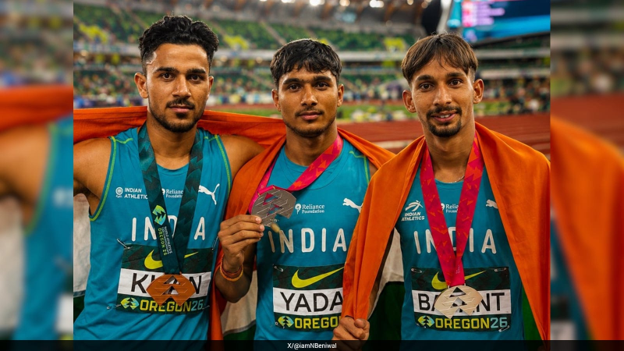
Basant Kumar Meghwal became the first Indian ever to win a high jump medal at the World Athletics U20 Championships. A day earlier, Shahnavaz Khan had also become the first Indian man to win a long jump medal at the same meet. And while neither result is enormous enough to make global headlines, it broke India’s massive wait for glory in the High and Long Jump events.
Table of Contents
- What Happened
- The High Jump Final: Basant's Silver
- The Long Jump Final: Shahnavaz's Bronze
- India's Full Medal Tally in Eugene
- The Neeraj Chopra Connection
- Why This Matters
- Conclusion
What Happened
The 2026 World Athletics U20 Championships ran from August 5 to 9 in Eugene, Oregon, drawing more than 1,800 athletes from 147 member federations, making it the largest edition of the junior global championship to date. India sent a 36-member squad, comprising 23 men and 13 women and over five days at Hayward Field, three Indian athletes reached the podium, a rare cluster of results for a country that has historically struggled for medals at this specific competition.
Javelin thrower Ashish Yadav opened India's account on August 7. High jumper Basant Kumar Meghwal and long jumper Shahnavaz Khan followed on August 8, delivering medals in events where India had never before finished in the top three.
The High Jump Final: Basant's Silver
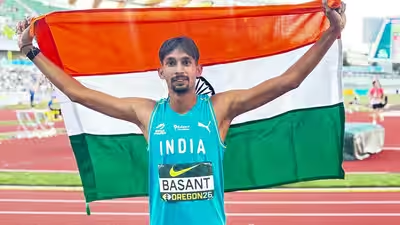
Basant Kumar Meghwal, a 19-year-old from Rajasthan, began the high jump final in strong form. He opened his campaign with a first-attempt clearance of 2.06m, before taking two attempts to clear 2.12m, and then managed to clear 2.17m cleanly on his first try. His decisive jump came at 2.21m, which he matched on his second attempt, equaling his own personal best.
That height set up a three-way tie for the podium. Algeria's Younes Ayachi, Great Britain's Otis Poole, and Basant all cleared 2.21m, but none could clear the following height of 2.24m in three attempts. The medals were decided on countback — a rule that ranks tied athletes by the fewest total attempts needed across the competition. Ayachi had cleared 2.21m on his very first try and took gold. Basant needed his second attempt and took silver. Poole, needing three attempts, settled for bronze.
Speaking to Olympics.com after the final, Basant reflected on the missed attempts at 2.24m, while claiming that he felt nervous during the attempts and felt like he just missed out on the gold but was already looking ahead to senior-level competitions, a mature response from an athlete who had cleared the same height to win gold at the Asian U20 Championships in Hong Kong a few months ago.
The Long Jump Final : Shahnavaz's Bronze
Shahnavaz Khan took a slightly different route to the podium. Making steady climb and progress across his three attempts, he opened with 7.67m, improved to 7.72m on his second attempt, and produced his medal-winning jump of 7.84m on his third.
Shahnavaz holds a personal best of 8.30m, set at the Indian Championships in June, marking his performance as relatively weaker to his own standards. Italy's Daniele Inzoli won gold with 7.97m, and Australia's Mason McGroder took silver with a personal-best 7.96m on his final jump. India's other finalist, R.C. Jithin Arjunan, finished eighth with a best effort of 7.59m.
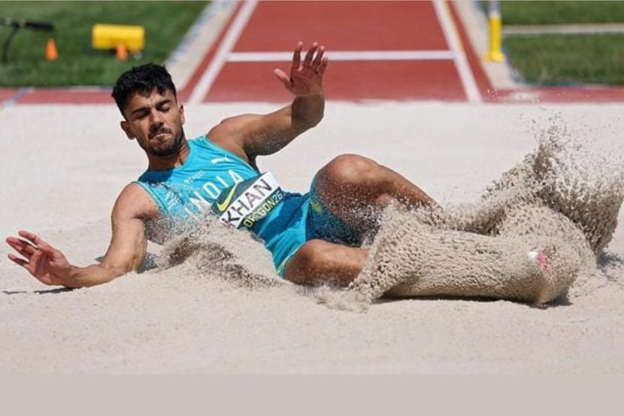
Even being short of his personal best, Shahnavaz’s bronze ensured glory by making him the first Indian man to win a medal in the long jump at the World U20 Championships. While Shaili Singh had won a silver in the women’s long jump category back in 2021, the men’s even had never produced an Indian medallist, a record that will stay with Shahnavaz for many years to come!
India's Full Medal Tally in Eugene
The jump medals further elevated India’s quiet and successful campaign in the U20 Championship at Eugene. Closing the tournament with a total tally of three medals, with two silvers and one bronze, India finished 20th in the overall medal tally, a good foundation to build on until the next championships.
|
Event |
Athlete |
Result |
Medal |
|
Men's Javelin Throw |
Ashish Yadav |
74.09m |
Silver |
|
Men's High Jump |
Basant Kumar Meghwal |
2.21m |
Silver |
|
Men's Long Jump |
Shahnavaz Khan |
7.84m |
Bronze |
Beyond the podium, Indian athletes also put in some notable performances with the women's 4x400m relay team of Bhoomika Nehate, Tahura Khatun, Tanu Chaudhary, and Thiya Arumugam advancing to the final after clocking 3:39.53 in their heat while Mohammed Ashfaq broke his own U20 national record in the 400m heats with a time of 45.81 seconds before finishing eighth in the final.
The Neeraj Chopra Connection
Ashish Yadav's silver medal with a 74.09m throw made him the second Indian man to win a javelin medal at the World U20 Championships, a decade after Neeraj Chopra won gold at the 2016 edition in Bydgoszcz, Poland, with a world U20 record of 86.48m that still stands today.
Neeraj Chopra, now a two-time Olympic medallist, took to social media to congratulate Ashish Yadav, calling the moment especially meaningful to him as a javelin thrower and telling the younger athlete this was "just the start." And while many would consider this as a gesture and acknowledgement, it subtly reflects India’s growing athletic strength with a pipeline of teenagers reaching finals on the same stage that he once did himself.
Why This Matters
India’s historic legacy at the World U20 Championships has been relatively slim. At the previous 2024 edition in Lima, Peru, the country finished last among medal-winning nations with a single bronze and their leap to the 2026 Championship, winning three medals across three different disciplines, represents a meaningful jump and growth in depth and performance at the same time.
And this growth isn’t simply happening at the World U20 level. Previously, India has also bagged a whooping tally of nine medals in a single day at the 2024 Asian U20 Championships in Dubai. And with four being gold medals amongst them, this simply marks the transition of talent getting exposure to the world stage and the promising future as the athletes gain greater experience and insight about competing at the world stage. And if these results are to be trusted, this is just the beginning of India’s medals tally at the World U20 championships.
Conclusion
India’s three medals didn’t come at the back of runaway performances, but the mere fact of them happening was enough to shatter headlines and get the spotlight towards Indian athletes. While many would argue that Basant winning on a countback of a three-way tie, Shahnavaz winning with an underwhelming performance or Ashish Yadav winning after a full decade is nothing to rejoice at, history has already been written and glory and pride are bound to follow through their legacies. For a country that has been steadily investing its resources and athletes to the junior and continental levels, Eugene 2026 was the beginning of reaping rewards at the global stage.
Latest Posts