

France Arrests Nearly 2,400 After Nationwide Cost-of-Living Protests Turn Violent, Limoges City Hall Torched
Consecutively, the French Prime Minister Sébastien Lecornu granted authority to local authorities to impose curfews as necessary while publicly downplaying the need of declaring an emergency and also announcing prompt measures and stringent actions to control and deescalate the protests and aid the affected individuals in due time.
Table of Contents
1. The Numbers at a Glance
2. What Led to Saturday
3. Limoges and Other Cities
4. The Government's Response
5. Political Fallout
6. How This Compares With 2018 and 2023
7. What Happens Next
8. Conclusion
The Numbers at a Glance
|
Metric |
Figure |
Source |
|
Arrests |
Nearly 2,400 |
France 24, AP |
|
Participants |
About 550,000 (ministry); 800,000 (CGT union) |
i24NEWS, CNBC |
|
Police and gendarmes injured |
Almost 1,000 |
France 24, CNBC |
|
Businesses looted or vandalized |
About 3,000 (Lecornu) |
NBC News |
|
Chambers of commerce estimate |
2,000+ businesses hit; "hundreds of millions of euros" |
France 24 |
|
Carrefour stores |
50 damaged, 20 looted |
Business Standard (Reuters) |
|
Deaths |
None, said Lecornu, calling it a "miracle" |
NBC News |
The arrest count rose through the weekend rising from about 1,200 on Saturday night to 1,800 on Sunday morning, and touching nearly 2,400 by Monday.
What Led to Saturday
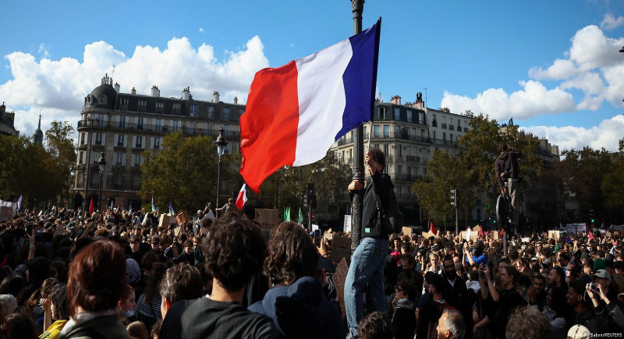
Built from the frustration of month-long student movement over teacher shortages and unsatisfactory schooling conditions, the marches are a testament of exhaustion and unrest within the French citizens and unions that carry their own broader grievances. Many protestors also joined the movement as an attempt to shed light towards the constantly rising cost of living, decline in quality of public services as well as higher fuel prices that impact the regular lives of the French citizens. The march became further activated when the former “Yellow Vest” activists, who played a significant role in protests of the past 10 years chose to join the movement, setting up mobilization paths and channels for seeking effective solutions. Notably, the protests and unrest arrived merely six months prior to a critical budget vote as well as the French Presidential elections, both events that could face heavy influence from the outcome of the protests.
Limoges and Other Cities
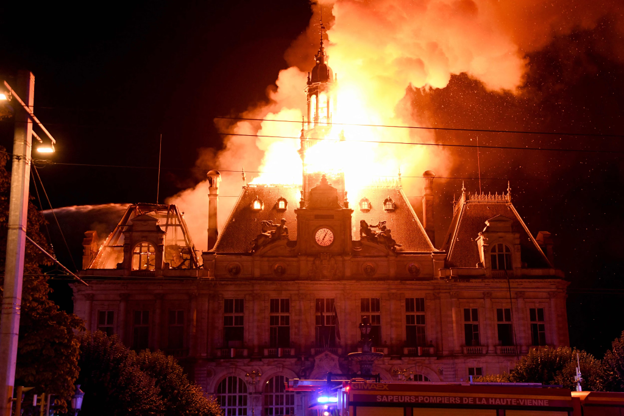
The most unfortunate and dramatic outcomes of the protest occurred in the city of Limoges, where masked individuals torched a city hall which was originally built in 1883 after also having burned a municipal police vehicle. The “break-in”occured when elected officials, employees and members of the public were still inside the building and resulted in only the ruins being left with over two-thirds of the exterior having been vanished into flames, including the hall’s own roof and bell tower.
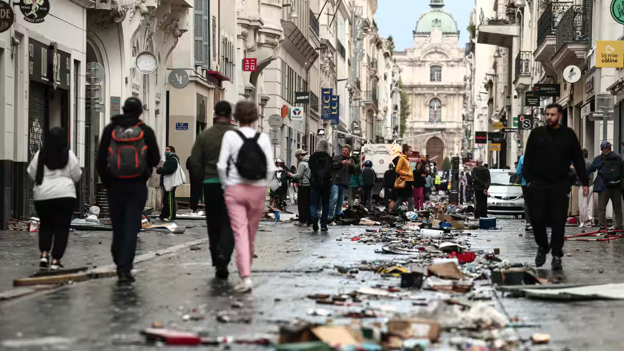
Furthermore, the violence continued to spread across various parts of France as protestors broke into city hall in Marseille causing damages while also setting fire at the tourist office in Lyon. Protestors in Paris shattered storefronts in the vicinity of Place de la République while other cities including Bordeaux, Lille, Rennes, Strasbourg, Grenoble and Nice were also all affected in the protest. Since the protests, certain allegations against the police have also emerged, especially following the incident of a teenager losing a hand while picking up a stun grenade and more than two dozen similar complaints of violence, cases that the police continue to investigate while also pacifying the situation across the nation.
The Government's Response
Addressing the nation through a televised address, the French President Macron claimed that he alongwith the French citizens experienced anger and shame while accusing the "insurrectionist elements from radical far-left groups, joined by numerous criminals” for orchestrating nation-wide disruptions and protests. During the addressal, Macron also provided assurance that he would find the looters in a fully transparent police response and would ensure they pay for their crimes while refusing to declare an official state of emergency. The French president also announced that a crisis unit would be chaired by Lecornu to provide aid and support to businesses that were affected due to the protests while also meeting unions, student groups and lawmakers in the near future.
Lecornu, following the president’s addressal and a crisis cabinet meeting, said that he had enabled regional authorities to impose partial and localised curfews in some cities that evening based on a necessary condition, while dismissing the idea of a curfew across all of Paris. Lecornu also assured that he was thoroughly determined to restore order and would not flinch before declaring a state of emergency if necessary. He completed his statement by accusing the “ultra-left movement” who he believed had orchestrated such protests to cause deep unrest before the presidential elections.
Political Fallout
Within the political discourse of France, both oppositional leaders have maintained a direct approach, with Lecornu alleging that the left-extremists were behind orchestrating the attack while the far-left leader Jean-Luc Mélenchon on the other hand held the government responsible for the destruction. Lecornu alongside other officials were also quick to hold Mélenchon's France Unbowed party as a contributing party while Far-right leader Marine Le Pen claimed that Macron’s government had now become exhausted and disoriented while the radical left was attempting to hijack legitimate demands while disguising their efforts in the form of protests around the nation.
How This Compares With 2018 and 2023
|
Dec. 8, 2018 (Yellow Vests) |
June–July 2023 (Nahel riots) |
Oct. 17, 2026 |
|
|
Trigger |
Fuel tax, cost of living |
Police killing of a teenager |
Cost of living, schools, public services |
|
Arrests |
1,723 in one day |
About 2,400 over four nights |
Nearly 2,400 over the weekend |
|
Injured |
264, including 39 police |
Not in reporting reviewed |
Almost 1,000 police |
What Happens Next
According to local reports, the Yellow Vest Movements which began with the 2018 riots have announced a new round of protests on Saturday, October 24 while the government has enabled local bodies to impose curfews and protest bans as necessary, a conflict that could be crucial to determine how the conflict plays out over the coming weeks. The France government, with mainly Lecornu also plans to hold talks with unions, students and lawmakers to help address and understand their economic grievances while working towards finding aid and possibly support plans for the future. Similarly, the government has also promised fair and transparent police investigations alongside aid for affected businesses, without any clear intimations of plans having been conveyed until today.
Conclusion
Over the past weekend, France has witnessed thousands of peaceful protestors that took to the city streets in marches over the weekend and resulted in catastrophic damage to about 3,000 businesses and a destroyed town hall that resulted in 2,400 individuals being put into custody. While the government has been quick to address the situation and provided prompt and fierce responses in the form of curfews, protest bans and transparent investigations to find those responsible, there are limited answers on addressing the core concerns that brought citizens onto the streets. As things stand, the political spaces continue to remain divided with various sides holding the other accountable for causing unrest prior to the presidential election and the next planned protest on Saturday and the measures implemented to address concerns by then could determine the extent of how the protests unfold over the coming weeks.
Latest Posts