

DRDOs Elite SFDR Missile Milestone

What Is SFDR ?
Essentially, SFDR is sophisticated Missile Propulsion using Solid-State Fuel and Air Breathing Ramjet. Fuel and Oxidiser are typically both carried by conventional rockets, however, the SFDR uses Solid State Fuel and has the ability to acquire Oxygen from the surrounding environment through purposely designed 'air in-take' structures.
Important Elements Of System:
1. Nozzle-less booster which will accelerate Missile through launch to supersonic speeds in about three seconds .
2. Solid-Fuel Ducted Ramjet Engine, that becomes activated once the speed is attained, which sustains speeds between Mach 2 - Mach 3.8 over long distances.
3. Cheek Mounted Air-intakes which will compress air on approaching the 'Air-intake' using a 3 ramp design, to efficiently feed the Ramjet with Air.
4. An Advanced Fuel-flow / Control Valve to control combustion based on altitude and speed, to keep acceptable thrust available.
The February test validated all of the above, The Nozzle-less booster ignited, the Ramjet activated, the Fuel Control Valve functioned, the Guidance System performed and all of the data collected from Radar, Electro-optical sensors and telemetry was confirmed by data collected along the Bay of Bengal .
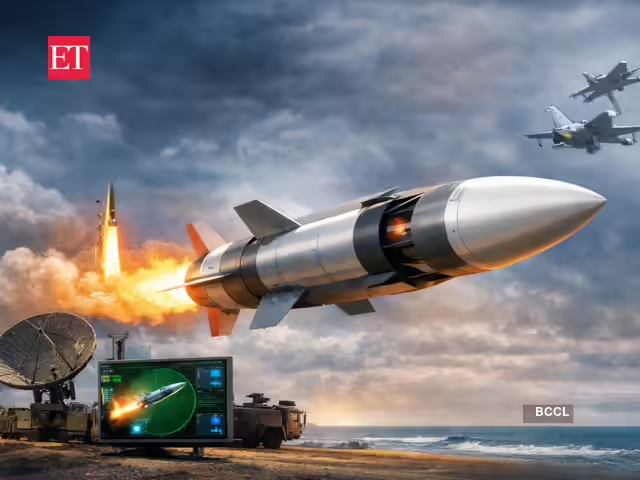
The Tactical Edge: A Bigger “No‑Escape Zone”
What is the air force excited about this technology?
The SFDR will give Missiles the Capability To:
- Maintain upper supersonic powered flight for a longer period than conventional Solid Rocket's.
- The ability to engage highly maneuverable targets from an altitude of Sea Level to 340 km and Sea Level to 20 km in altitude.
- Execute vertical "snap-up" or "snap-down" maneuvers up to 10 km, providing pilots with greater flexibility in steep angle of attack engagements.
Consequently, there shall be many more no-escape zones from which the enemy’s aircraft can’t outrun or out-turn the missiles.When combined with RF seekers, Inertial Navigation, and Jam-Resistant Data Links, the SFDR makes it very difficult for adversary aircraft that engage in beyond visual range (BVR) combat to survive.
Strategically, this could elevate India's status from being a consumer of technology such as Meteor to becoming a Tier 1 peer manufacturer of that technology.
From Tech Demo to Astra Mk‑3
SFDR will be implemented in a series of applications beyond just one single science experiment. SFDR is a new propulsion system designed specifically for the (new) Astra missiles, particularly the Astra Mk. 3 (long-range air-to-air missile).
Currently the Astra Mk. It has a range (110 km) between 100+ km and the Astra Mk. II (target range will be 200 km or greater).
The Astra Mk. III is projected to have a maximum range of 350 km with sustained speeds between Mach 2 and 3.8, and high-G manoeuvrability throughout its destruct period.
The design is touted by both experts and DRDO as having the potential to be used in adapting the same engine for surface-to-air missiles to enhance India's air defence capability through developing a separated but integrated national air defence system.
Hence, SFDR is not a single solution but a technology platform that can support multiple coordinated designs of missile families.
The Business Angle: Who Gains?
There’s a major ripple effect in India’s defence domain:
- HAL and other airframe/platform integrators will see an increase in work related to the development and integration of Astra Mk-3 on platforms such as Su-30MKI and Tejas as well as future platforms through upgrades, flight-testing contracts and long-term support services.
- Missile producers will receive multiyear production contracts when the system is inducted along with producing high-value and complex components like propulsion and structure.
- Suppliers of RF seeker electronics, inertial sensor electronics and data link electronics will be able to capture a large share of the value created per missile sold.
- As a lot of friendly nations are operating with India, more export opportunities will emerge, by transforming SFDR into an export lever, rather than just using it domestically.
- Most importantly, this will move India from being primarily a consumer of advanced BVR missiles to being an IP owner and supplier in a space currently occupied by only a select number of countries.
Risks and Execution Challenges
Three obstacles remain (and they are all difficult to overcome):
- It is not easy to go from success with one test to have a uniformly successful series of production through the necessity for stringent materials, tolerances, and quality controls.
- It will take about three (3) years of flight testing and user evaluation for full integration of the Astra Mk-3 on multiple IAF platforms.
- The competing budget priorities must take into account the SFDR along with the UAVs, fighters and naval programs.
However, the message is clear! India has made an effort to position itself for the future air power strategy.
Why This Milestone Deserves Attention
To put it simply, the basics of these tests are as follows.
- In the future, missile systems that Indian pilots have been trained on will be able to outrange most advanced weapon systems that their peers in the other countries have. They will also survive longer in BVR combat.
- It will also provide Indian industry with some of the highest-end, exportable technology that no other country has been able to sell.
- Investors and policymakers can use this as another example of how deep tech defence R&D coming out of India can be commercialised and fielded and not be resting only in slide presentations.
That is why this test is being regarded as an “elite club” milestone. It is not only about travelling at Mach 3.8; it signifies that India can design, develop, and continue to operationalise its own advanced propulsion technologies and capabilities in modern warfare.
Latest Posts