

Coinbase Launches Agentic Wallets for Autonomous AI
What Are “Agentic Wallets” Exactly?
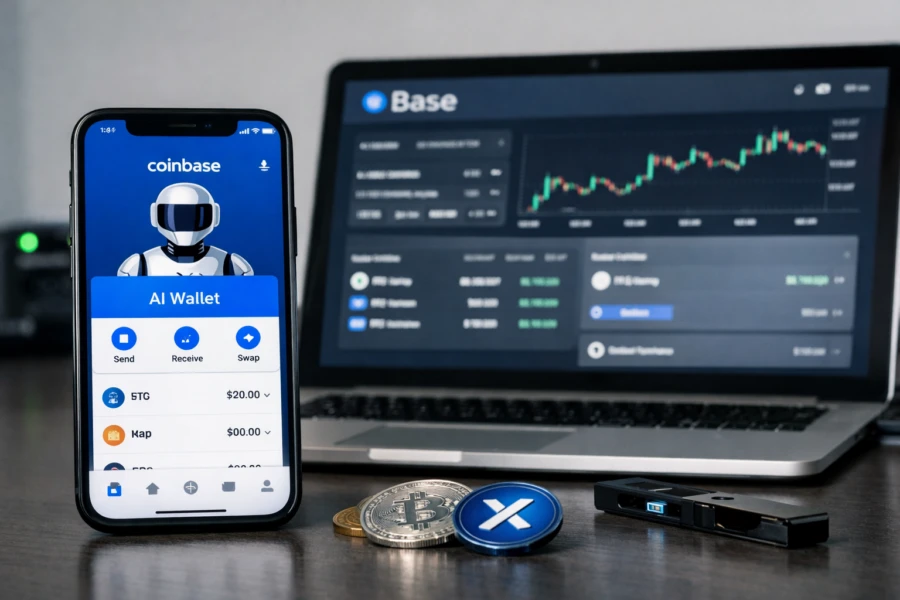
Basically, agentic wallets represent a new type of cryptocurrency wallet designed solely for autonomous AIs instead of people. Autonomous AI systems can use agentic wallets to hold stable coins/tokens, pay for services/APIs, trade/rebalance their portfolios, and even generate yield through decentralized finance (DeFi) without requiring human approval before conducting any of these transactions.
What makes agentic wallets different from traditional wallets is that all transactions occur according to predefined rules/guardrails. In order for this to happen, agentic wallets utilize the Coinbase x402 protocol, an entirely new machine payment standard designed specifically for programmatic (i.e. spontaneous) transfers between different machines. Thus, you can think of the x402 protocol as an API layer that enables agents to transfer funds as easily as they can make an HTTP request.
Why Coinbase Is Doing This
Currently, lots of AI apps provide trade recommendations, summarise research or find an appropriate API, but run out of gas when it comes to actually moving money. Human intervention is still required to log in, sign and send. Coinbase is betting that the next generation of autonomous AI agents will not only recommend actions but will also now perform these actions!
Coinbase is exploring giving each of its AI agents their own AI crypto wallets, with the following goals:
- Removing friction in automated workflows by eliminating required human input on an ongoing basis.
- Positioning itself as a core infrastructure provider for the growing "agent economy" where non-human entities will transact at scale.
- Locking developers into its stack (Base L2, x402, custodial) as the default rail for AI-driven financial transactions.
- Strategically, this action shifts Coinbase's business from being a "trading platform" towards becoming a "payment railroad for agentic software applications".
How They Work in Practice
As a builder, the design of Agentic's proof of concept is deliberately opinionated in respect of:
1. x402 and Machine to Machine Payments.
The x402 protocol acts as the backbone of this interaction, allowing machines to programmatically send and receive value like HTTP does for web communication. Developers can create an Agentic Wallet using the CLI, fund the wallet and allow the AI agent to; 1. Send funds 2. Swap tokens 3. Pay for computing services or APIs 4. Earn yield through DeFi using a library of pre-built functions rather than having to write their own blockchain code
Agentic wallets are optimally designed for Base (Coinbase Layer 2 network) with gasless transactions to ensure that transactions are not stalled due to the unavailability of network fees.

2. Smart Security Guardrails
The word autonomy means the absence of constraints; however, this does not apply to how agentic wallets function. Each wallet comes equipped with smart security guardrails to provide risk mitigation through:
1. Spending limits on a per session basis and per transaction
2. Programmable limits on contracts or addresses the agents are allowed to interact with
3. KYT/compliance screening is in place to prevent agents from engaging with high-risk or sanctioned parties.
It is important to note that private keys are kept isolated from AI models. Keys are secured within Coinbase’s secure hardware (enclaves) and never leave the server so they cannot be written in prompt and logs; therefore, when companies use autonomous agents, they maintain their cryptographic controls without trusting third parties or the AI.
What This Unlocks
By using AI and crypto wallets, you can visualize that agents ...
- Continue to adjust a portion of the treasury for hard caps.
- Automatically purchase APIs or GPU time as usage exceeds limits.
- Operate pay-per-use models or enable IoT devices to bill themselves using an on-chain payment process.
Individuals or businesses who have access to fintech and SaaS products will soon have AI acting on their behalf as the end user for these products; therefore the method of charging, granting permission and monitoring involved with these types of payments will need to change.
Coinbase's strategic plan for AI Payment Infrastructure is to use Base and x402 as the foundation to be for agents what Stripe is to web payments - powerful - however they also expose themselves to platform dependence if their policy or uptime falters.
Risks and Governance
As businesses let their software spend, there will always be major concerns.
Coinbase's solution is putting in place constraints, like logging, whitelisting, and compliance policies, to ensure that the wallet is properly secured.
- Businesses that choose to go all-in on Agentic wallets still need to build out:
- Internal policies on agentic spending (e.g. what agents can spend on, how much they can spend, when agents can spend).
- Oversight and anomaly detection for all agentic spending.
As the amount of machine to machine payments increases, we can expect regulatory focus to increase as well on KYC, beneficial ownership, and liability.
From Assistants to Economic Actors
In conclusion, we see that AI agents are moving toward becoming real economic entities in addition to being advisors. Coinbase's Agentic wallets are early-stage infrastructure that will enable the evolution of autonomous AI agents as economic participants.
For builders, this provides an opportunity to develop products that feature software as the spender. For large corporations, this is a catalyst for re-evaluating how they govern AI or treasury function for the future.
Latest Posts