

Cloud 3.0 and the End of Coding Why 2026 is Being Called the Year of Truth for Global AI
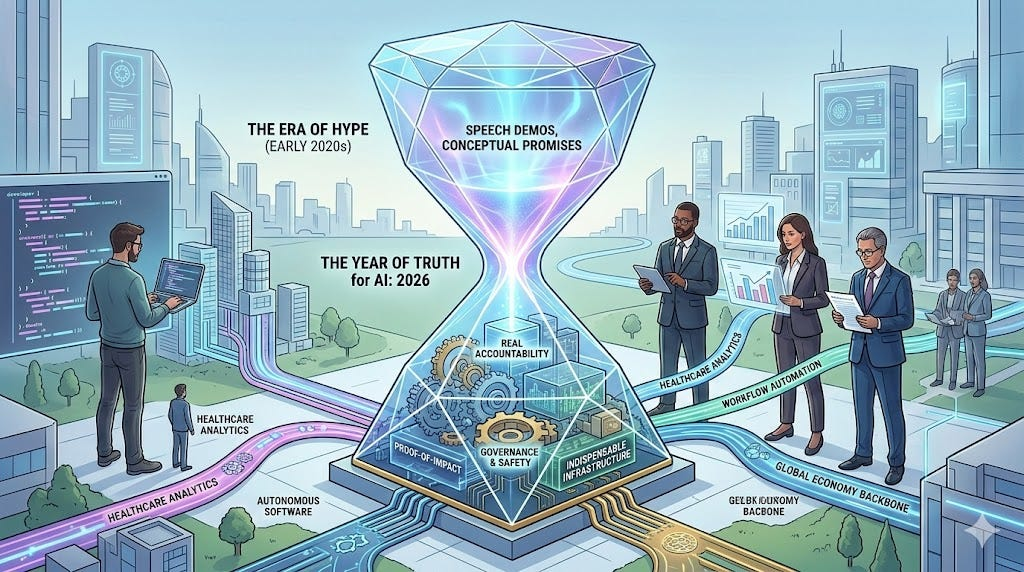
Ultimately, this shift will rely on Cloud 3.0 with its new agentic platforms and AI-native architectures that are making the transition from coding to intent-driven orchestration, where the person decides the goal, while machines perform the required tasks.
From Hype to Impact: The Year of Truth
Capgemini’s TechnoVision 2026 report frames this as the moment AI moves beyond “proof‑of‑concept” to “proof‑of‑impact”—measurable, enterprise‑grade adoption with governance and trust baked in from day one. After years of fragmented experiments, organisations are rebuilding software with AI at the core, demanding “human‑AI chemistry” where outcomes are adaptive, coherent, and accountable.
The shift is structural. LinkedIn analyses and industry leaders converge on 2026 as the tipping point where AI‑native development platforms span code generation, test synthesis, autonomous refactoring, and multi‑agent orchestration. Tiny teams now ship production‑grade applications in parallel, fundamentally reshaping build‑versus‑buy decisions, operating models, and governance.
Cloud 3.0: The Agentic Backbone
Cloud 3.0 provides additional capabilities beyond just traditional Artificial Intelligence (AI) and Machine Learning (ML) in the form of Large Language Models (LLMs) and Autonomous Agents (AA), both of which can be utilized to create complex workflows via orchestration. Cloud 3.0 enables use of technology such as Claude Code, OpenAI Codex, and Cursor to develop entire software features autonomously by having developers only supply a specification (e.g., “Build a secure login system which has encrypted tokens and has full test coverage”) and allowing the Automaton Agent to provide an entire system architecture, design, code all files, write test cases, repair bugs and deliver the completed version to the developer.
What used to take an average of about 2 days now takes just a few minutes thanks to AI..AI generalists can prototype and validate new solutions by using API's or low code platforms with little to no prior experience, bridging the gap between business needs and the associated technical capabilities..Resilience and MuliCloud Sovereignty are a given, but AI native systems also have the ability to create/test/repair their own systems without the involvement of anyone from human resources.
The End of Coding
The major shift in the evolution of programming will be a move away from coding lines of code and moving towards a focus on how we express intent when coding. Software 3.0 has put AI Agents into the first class of contributors which will fundamentally change how we develop platforms, build pipelines and govern our use of these platforms. There are predications that by the year 2026 AI will produce 90% of all code, thus putting an end to manual coding as the primary method for creating software.
This is not just hype, there are companies today, which are built on an AI-native platform who today are reshaping how a product is created and how we do our work. The role of the developer is changing into that of an orchestrator for AI co-builders and what we call “Vibe Coding”, will become an enterprise's playbook for development. Multicloud architectures, post-quantum (secure computing), and neuromorphic processors provide the infrastructure required to develop low-latency edge AI technologies; and the convergence of Mult-AI-Agents with these technologies will enable us to create autonomic systems for use in our day-to-day operations.
Business Implications
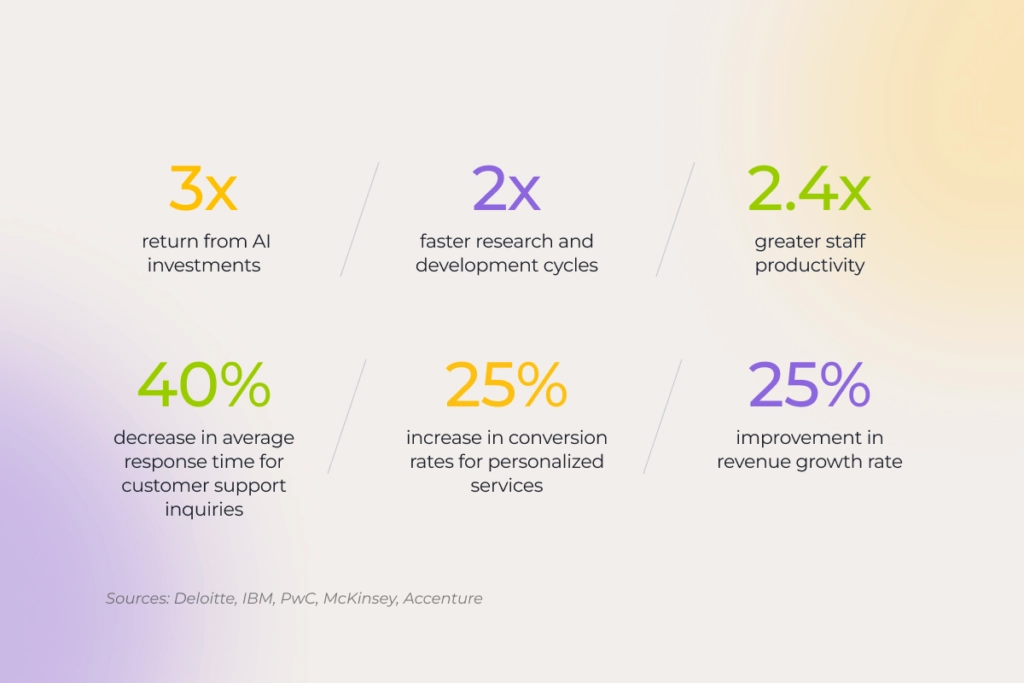
The productivity acceleration happening now is enormous. The small teams develop at an increased rate with AI development partners, creating more opportunities in the build vs buy environment. Companies are concentrating on building trust, governance, and scalable, AI-led systems (where AI is considered the core, not supplemental).
Therefore, enterprises will have to recreate the way they do work; humans will deal with complex decisions (ex: Load Balancer v. API Gateway, microservices v. monolith) and AI will handle the regular execution of these tasks. Sales 3.0 and Software 3.0 will integrate and enable autonomous sales to support automated revenue operations from planning through production.
The Indian Angle: From Services to AI‑Native
The IT industry, traditionally known as a 'code shop,' is going through a huge change. NASSCOM projects that the AI workforce in India will grow from 625,000 in 2022 to 1.25 million by 2027. However, many routine coding jobs face a 60% risk of being fully automated. Companies such as Tata Consultancy Services (TCS) and Infosys are offering their employees training in AI fluency, positioning themselves as organisers of workflows that involve agents rather than 'code mills.'

Urban Startups and Global Capability Centres are experimenting with 'vibe coding' and AI to 'co-pilot' to shorten the time between initiating and completing a new product from months to weeks. The challenge will be how to quickly upskill a large number of people while reorganising for independence and multicloud resilience in the face of threats created by the future development of quantum computers.
Risks and Realities: Beyond the Hype
2026’s truth includes sobering realities. High‑profile outages in 2025 exposed AI system fragility; organisations now redesign for resilience. Governance demands “human‑AI chemistry” to ensure accountability—AI excels at execution but struggles with nuanced trade‑offs requiring lived experience.
The question evolves from “Can AI do this?” to “How well, at what cost, and who bears the risk?” Those answering effectively build durable foundations; others risk stranded pilots and inflated infrastructure spends.
What Comes Next: Orchestration Over Coding
From 2026 onwards, expect a combination of AI-native platforms with specialized chips for energy-efficient edge artificial intelligence (AI) and autonomic systems, which will be self-optimizing. Software engineering will become a combination of intent, governance, and orchestration with an ever-present artificial intelligence (AI) co-creating.
For business leaders, replacing developers is not the same thing as redefining what development will mean. The end of coding in 2026 and Cloud 3.0 require a choice between either orchestrating your future or being orchestrated by it; 2026 will be the Year of Truth, which requires action and not passive observation.
Latest Posts